The month of Ramadan is the month in which the Quran was sent down,
a guidance for the people, and clear verses of guidance and criterion.
[Quran: Chapter 2:183]

Sponsored

Sunday, July 31, 2011

Quran Verses About Ramadan

What Does the Holy Quran Say About Fasting?

Every year during Ramadan, Muslims all around the world embark on fasting. What exactly does the Holy Quran say about fasting? Let us examine the few Quranic verses on fasting.

Surah Al-Baqara (The Cow) 2:183

O ye who believe! Fasting is prescribed to you as it was prescribed to those before you, that ye may (learn) self-restraint,

Surah Al-Baqara (The Cow) 2:184

(Fasting) for a fixed number of days; but if any of you is ill, or on a journey, the prescribed number (Should be made up) from days later. For those who can do it (With hardship), is a ransom, the feeding of one that is indigent. But he that will give more, of his own free will,- it is better for him. And it is better for you that ye fast, if ye only knew.

Surah Al-Baqara (The Cow) 2:185

Ramadan is the (month) in which was sent down the Qur'an, as a guide to mankind, also clear (Signs) for guidance and judgment (Between right and wrong). So every one of you who is present (at his home) during that month should spend it in fasting, but if any one is ill, or on a journey, the prescribed period (Should be made up) by days later. Allah intends every facility for you; He does not want to put to difficulties. (He wants you) to complete the prescribed period, and to glorify Him in that He has guided you; and perchance ye shall be grateful.

Surah Al-Baqara (The Cow) 2:187

Permitted to you, on the night of the fasts, is the approach to your wives. They are your garments and ye are their garments. Allah knoweth what ye used to do secretly among yourselves; but He turned to you and forgave you; so now associate with them, and seek what Allah Hath ordained for you, and eat and drink, until the white thread of dawn appear to you distinct from its black thread; then complete your fast Till the night appears; but do not associate with your wives while ye are in retreat in the mosques. Those are Limits (set by) Allah. Approach not nigh thereto. Thus doth Allah make clear His Signs to men: that they may learn self-restraint.

Surah Al-Baqara (The Cow) 2:196

And complete the Hajj or 'umra in the service of Allah. But if ye are prevented (From completing it), send an offering for sacrifice, such as ye may find, and do not shave your heads until the offering reaches the place of sacrifice. And if any of you is ill, or has an ailment in his scalp, (Necessitating shaving), (He should) in compensation either fast, or feed the poor, or offer sacrifice; and when ye are in peaceful conditions (again), if any one wishes to continue the 'umra on to the hajj, He must make an offering, such as he can afford, but if he cannot afford it, He should fast three days during the hajj and seven days on his return, Making ten days in all. This is for those whose household is not in (the precincts of) the Sacred Mosque. And fear Allah, and know that Allah Is strict in punishment.

Labels:

Special Ramadan Series

Dear Reader, Assalaamu’alaikum.

Ramadan Mubarak. We wish you a blessed and productive Ramadan! Make no mistake about it - keeping the fast and increasing our acts of worship during this blessed month is not an easy task. The physical demands of balancing work or school with fasting all day, feeling fatigued and less effective than you normally are, waking up for Suhoor, praying Teraweeh and Tahajjud prayers, dealing with sleep deficits.

But the last thing we would want is to let Ramadan pass us by without doing all that we aim and desire to. Do not allow yourself to feel guilty or regretful when Ramadan passes.

The Ramadan Series will send you emails with practical tips on how to gain and maintain the physical and spiritual energy necessary to embark on increased religious oligations so that you will reap the benefits from this blessed month. This includes special Ramadan duas to say during the month. Do sign-up today!

* Email
First Name
Last Name
* = Required Field

Article Link

Share

Friday, August 27, 2010

Trust in Allah

Ramadan Message: Trust in Allah
Ramadan Messages for 2010
Day 17


"Put your trust in the All-Mighty, the Most Merciful"
(Holy Quran, 12:217)

Many of us live our lives in fear. We fear not getting what we strive for, we fear losing what we do have, and we fear even aiming for something we do want.

But recall this: [The Caliph] 'Umar ibn al-Khattab (may Allah be well pleased with him) is reported as having said: "Allah's Messenger (Allah bless him and give him peace) once said: "If you really and truly placed all your trust in Allah totally, He would sustain you as He sustains the birds. They start the day with their bellies empty, and return back with their bellies full."


This absolute trust in Allah is called tawakkul.

The real meaning [haqiqa] of absolute trust [tawakkul] is delegating all one's affairs to Allah (Almighty and Glorious is He), making a clean escape from the murky darkness and gloom of personal choice and self-management, and advancing to the arenas where the [divine] decrees [ahkam] and foreordainment [taqdir] are experienced directly.

The servant [of the Lord] must be convinced that there is no possibility of changing the allotment of destiny [qisma], which means that whatever has been allotted to him cannot pass him by, and that he can never obtain what has not been allotted to him. His heart will then become reconciled to this, and he will feel confident in relying on the promise [wa'd] of his Master [Mawla]. He will therefore receive from his Master [Mawla].

Putting one's trust in the Lord [tawakkul] is actually the first of three stages, namely: (1) the basic sense of trust [tawakkul], then (2) the act of surrender or resignation [taslim], and then (3) the act of delegation [tafwid]. The person who is at the stage of basic trust [al-mutawakkil] is one who feels confident in relying on the promise [wa'd] of his Lord. The person who is at the stage of surrender or resignation [sahib at-taslim] is one who is content to rely on His knowledge ['ilm]. The person who is at the stage of delegation [sahib at-tafwid] is one who is happy to accept His judgment [hukm].

From: Al-Ghunya li-Talibi Tariq al-Haqq, Chapter 3


Absolute trust in the Lord [tawakkul] is living one day at a time, and dispensing with concern about tomorrow.

It is the constant fears, doubts and worries that stymie our happiness in this life. Remember that what happens only happens because Allah wills it so. That should not stop us from seeking out what we need as do the birds seek out the food it needs daily; rather we should place trust in Allah that he will provide for us what is best for us. If we do not attain what we seek despite our best efforts, then accept it and trust that it was for the best! If something is meant, it will happen, regardless of what we do or do not do.

Dispense with fear, doubt and worry. Replace it with trust in Allah.

"And why should we not put our trust in Allah while He indeed has guided us our ways. And we shall certainly bear with patience all the hurt you may cause us, and in Allah (Alone) let those who trust, put their trust."
(Holy Quran, 12:14)


Ramadan Message 2010: Ramadan Dua Accepted?

Ramadan Message 2010: Gratitude

Ramadan Message 2010: Charity


Ramadan Message 2010: Dua

Ramadan Message 2010: Patience


Labels: ,

Special Ramadan Series

Dear Reader, Assalaamu’alaikum.

Ramadan Mubarak. We wish you a blessed and productive Ramadan! Make no mistake about it - keeping the fast and increasing our acts of worship during this blessed month is not an easy task. The physical demands of balancing work or school with fasting all day, feeling fatigued and less effective than you normally are, waking up for Suhoor, praying Teraweeh and Tahajjud prayers, dealing with sleep deficits.

But the last thing we would want is to let Ramadan pass us by without doing all that we aim and desire to. Do not allow yourself to feel guilty or regretful when Ramadan passes.

The Ramadan Series will send you emails with practical tips on how to gain and maintain the physical and spiritual energy necessary to embark on increased religious oligations so that you will reap the benefits from this blessed month. This includes special Ramadan duas to say during the month. Do sign-up today!

* Email
First Name
Last Name
* = Required Field

Article Link

Share

Friday, August 20, 2010

Ramadan Message 2010: Showing Gratitude

Ramadan Messages and Daily Reminders for 2010
Day 10


Some of you may feel weary and tired during Ramadan, and that is normal because we are fasting, and yet continuing with life's many responsibilities from housework, child-rearing, school and work. But we hope these short but insightful Ramadan reminders will inspire you to persevere through times of difficulties during this Ramadan. InshaAllah.


Prophet Muhammad (peace be upon him) said: "He is successful who has accepted Islam, who has been provided with sufficient for his wants and been made contented
by Allah with what He has given him."


"If you count God's blessings, you can never encompass them all.
Indeed, the human being is transgressing, unappreciative."
Quran 14:34

"Say, "Nothing befalls us, save what God has decreed for us. He is our Lord and Master. In God the believers shall trust."
Quran 9:51


The Importance of Showing Gratitude

When good things come over way, we are happy and content. We neglect to realize that the good in our lives come from God, and we neglect to show proper gratitude to God for it. We take for granted the many good things that God has given us - our family members, our friends, our health, and even our ability to see, hear, speak and reason! And yet we constantly yearn for more than what we have, and then get depressed or angry when what we desire is not forthcoming. Then we begin to question God - how dare us?!

Wanting more is human nature, and wanting more is not necessarily a sin. But it is important to be thankful for what we do already have. Why should God answer our prayers for more, when we do not show Him the proper gratitude for the things we already have?

True believers are aware that all good things that happen to them in life surely come from God alone. This message is quite clear in the Quran. Believers are also assured that no one other than God has any power to harm or benefit them, for nothing befalls them except what God has decreed.

Only those who are genuinely content with what they already have, will be the ones to attain true happiness in this life. After all, it has been said that true happiness is not having what you want, but wanting what you have.

The Salaf and their Gratitude
Taken from 'Patience and Gratitude'
By Ibn Qayyim


Labels: ,

Special Ramadan Series

Dear Reader, Assalaamu’alaikum.

Ramadan Mubarak. We wish you a blessed and productive Ramadan! Make no mistake about it - keeping the fast and increasing our acts of worship during this blessed month is not an easy task. The physical demands of balancing work or school with fasting all day, feeling fatigued and less effective than you normally are, waking up for Suhoor, praying Teraweeh and Tahajjud prayers, dealing with sleep deficits.

But the last thing we would want is to let Ramadan pass us by without doing all that we aim and desire to. Do not allow yourself to feel guilty or regretful when Ramadan passes.

The Ramadan Series will send you emails with practical tips on how to gain and maintain the physical and spiritual energy necessary to embark on increased religious oligations so that you will reap the benefits from this blessed month. This includes special Ramadan duas to say during the month. Do sign-up today!

* Email
First Name
Last Name
* = Required Field

Article Link

Share

Thursday, August 19, 2010

Ramadan Message 2010: Charity

Ramadan Messages and Daily Reminders for 2010
Day 9


Some of you may feel weary and tired during Ramadan, and that is normal because we are fasting, and yet continuing with life's many responsibilities from housework, child-rearing, school and work. But we hope these short but insightful Ramadan reminders will inspire you to persevere through times of difficulties during this Ramadan. InshaAllah.

Prophet Muhammad (saw) said: "Richness does not lie in the abundance of worldly goods, but richness of the richness of the soul (heart, self)"


(Have you seen the one who denies the Religion? Such is he who repulses the orphan, and who does not urge others to feed the poor. Woe to worshippers, who are absent-minded to their prayer, those who make a show (of piety), and refuse to render small acts of kindness (towards others).) (Al-Ma`un 107: 1-7).


Prophet Muhammad(saw) said: "It is imperative on every one to render acts of charity every single day that sun shines in the sky in order to express gratitude to Allah for every single joint or faculty in his body. It is charity to restore peace between two people with strained relations, it is charity to give a stranded person a ride on his mount or lift his load onto it, it is charity to utter a good word, every step one takes towards mosque for prayer is charity, to remove litter or objectionable things from people’s path is charity."


So please remember to do charity this Ramadan, and continue it after Ramadan, so that you can ensure you are on the right side of the Fate that you desire. InshaAllah.

"You cannot attain to righteousness unless you spend (in charity) out of what you love." (The Holy Quran 3:92)

The Importance of Charity

Charity, for which the expression used in the Holy Quran is "spending out of what God has given you". Giving charity does not have to be only money. Charity can also be given by using your energy, talent, resources, money, possessions, or whatever else, to help and do good to those in need.

In Islam, charity is very often mentioned alongside prayer because just as the latter is man's relation with God, or man's duty towards God, the former (charity) represents his relation with his fellow-beings, and indeed with all the creation of God.

Prayer expresses love for God, submission to Him, and a desire to bring out the Divine qualities that lie hidden in every person. Charity is an expression of sympathy and benevolence towards God's creation, putting into actual practice the lessons you learn in prayer.

Labels: ,

Special Ramadan Series

Dear Reader, Assalaamu’alaikum.

Ramadan Mubarak. We wish you a blessed and productive Ramadan! Make no mistake about it - keeping the fast and increasing our acts of worship during this blessed month is not an easy task. The physical demands of balancing work or school with fasting all day, feeling fatigued and less effective than you normally are, waking up for Suhoor, praying Teraweeh and Tahajjud prayers, dealing with sleep deficits.

But the last thing we would want is to let Ramadan pass us by without doing all that we aim and desire to. Do not allow yourself to feel guilty or regretful when Ramadan passes.

The Ramadan Series will send you emails with practical tips on how to gain and maintain the physical and spiritual energy necessary to embark on increased religious oligations so that you will reap the benefits from this blessed month. This includes special Ramadan duas to say during the month. Do sign-up today!

* Email
First Name
Last Name
* = Required Field

Article Link

Share

Ramadan Message 2010: Dua

Ramadan Messages and Daily Reminders for 2010
Day 8


Some of you may feel weary and tired during Ramadan, and that is normal because we are fasting, and yet continuing with life's many responsibilities from housework, child-rearing, school and work. But we hope these short but insightful Ramadan reminders will inspire you to persevere through times of difficulties during this Ramadan. InshaAllah.

Ramadan is the month in which the Holy Quran was sent down, as a guide to mankind with clear signs for our guidance and judgement.


Prophet Muhammad (saw) said: "Bear in mind that if all the people combined together to grant you some benefit, they would not be able to do it unless Allah has determined it for you. And if all of them combined together to do you harm, they would not be able to do it unless Allah has determined it for you. The pens have been set aside and writings of the Book of Fate have become dry."

So make duas (supplications) this Ramadan so that you can ensure you are on the right side of the Fate that you desire. InshaAllah.

The Importance of Making Dua and How to Do it - Video

Dua (supplication) is the most powerful weapon of the believer and a means of communicating with his Lord. Shaykh Yasir Qadhi elaborates on the status, importance and etiquette of dua' in Islam. For more information and details please refer to the book published by the speaker of the same title which is the most comprehensive work yet to be written in English on the topic, the author discusses, amongst other matters: the excellence and benefits of du'a; the types of du'a; the pre-conditions that are needed in order for a du'a to be accepted; the recommended etiquette of performing du'a; the timings and situations in which a du'a is more likely to be answered; the various factors that aid or prevent a du'a from being accepted; the relationship of du'a with the Divine Decree (qadr); the wisdom behind a delayed response, and many other relevant topics.

Yasir Qadhi was born in Houston, Texas and completed his primary and secondary education in Jeddah, Saudi Arabia. He graduated with a B.Sc. in Chemical Engineering from the University of Houston, after which he was accepted as a student at the Islamic University of Madinah. After completing a diploma in Arabic, he graduated with a B.A. from the College of Hadith and Islamic Sciences. Thereafter, he completed a M.A. in Islamic Theology from the College of Dawah. His published works include Riya'a: The Hidden Shirk, Du'aa: The Weapon of the Believer, and An Introduction to the Sciences of the Qur'an.

Labels: ,

Special Ramadan Series

Dear Reader, Assalaamu’alaikum.

Ramadan Mubarak. We wish you a blessed and productive Ramadan! Make no mistake about it - keeping the fast and increasing our acts of worship during this blessed month is not an easy task. The physical demands of balancing work or school with fasting all day, feeling fatigued and less effective than you normally are, waking up for Suhoor, praying Teraweeh and Tahajjud prayers, dealing with sleep deficits.

But the last thing we would want is to let Ramadan pass us by without doing all that we aim and desire to. Do not allow yourself to feel guilty or regretful when Ramadan passes.

The Ramadan Series will send you emails with practical tips on how to gain and maintain the physical and spiritual energy necessary to embark on increased religious oligations so that you will reap the benefits from this blessed month. This includes special Ramadan duas to say during the month. Do sign-up today!

* Email
First Name
Last Name
* = Required Field

Article Link

Share

Ramadan Day 7 Message 2010

Ramadan Messages and Daily Reminders for 2010

Some of you may feel weary and tired during Ramadan, and that is normal because we are fasting, and yet continuing with life's many responsibilities from housework, child-rearing, school and work. But we hope these short but insightful Ramadan reminders will inspire you to persevere through times of difficulties during this Ramadan. InshaAllah.


Prophet Muhammad (saw) said: " A great month has come over you: a blessed month; a month in which is a night better than a thousand months; it is the month of patience and the reward for patience is Heaven.

Labels: ,

Special Ramadan Series

Dear Reader, Assalaamu’alaikum.

Ramadan Mubarak. We wish you a blessed and productive Ramadan! Make no mistake about it - keeping the fast and increasing our acts of worship during this blessed month is not an easy task. The physical demands of balancing work or school with fasting all day, feeling fatigued and less effective than you normally are, waking up for Suhoor, praying Teraweeh and Tahajjud prayers, dealing with sleep deficits.

But the last thing we would want is to let Ramadan pass us by without doing all that we aim and desire to. Do not allow yourself to feel guilty or regretful when Ramadan passes.

The Ramadan Series will send you emails with practical tips on how to gain and maintain the physical and spiritual energy necessary to embark on increased religious oligations so that you will reap the benefits from this blessed month. This includes special Ramadan duas to say during the month. Do sign-up today!

* Email
First Name
Last Name
* = Required Field

Article Link

Share

Sunday, August 23, 2009

What to Avoid During Ramadan

We came across this excellent article via an email forward recently. The following article contains useful reminders on what NOT to do during Ramadan - a valuable read indeed. The holy month of Ramadan will be over before we even realise it - so while we have the time, we should make good use of it by spending more time on our spiritual objectives. Ramadan only come once a year - seize the opportunity to reap in good for yourself and your family while it lasts.

1. Taking Ramadaan as a ritual: For many of us Ramadaan has lost its spirituality and has become more of a ritual than a form of Ibaadah. We fast from morning to night like a zombie just because everyone around us is fasting too. We forget that its a time to purify our hearts and our souls from all evil. We forget to make dua, forget to beseech Allaah to forgive us and ask Him to save us from the Fire. Sure we stay away from food and drink but that's about all.

Although the Prophet (Sal Allaahu Alaiyhi wa Sallam) said: "Jibreel said to me, 'May Allaah rub his nose in the dust, that person to who Ramadaan comes and his sins are not forgiven,' and I said, 'Ameen'. Then he said, 'May Allaah rub his nose in the dust, that person who lives to see his parents grow old, one or both of them, but he does not enter Paradise (by not serving them) and I said, 'Ameen'. Then he said, 'May Allaah rub his nose in the dust, that person in whose presence you are mentioned and he does not send blessings upon you,' and I said, 'Ameen.'" (Tirmidhi)

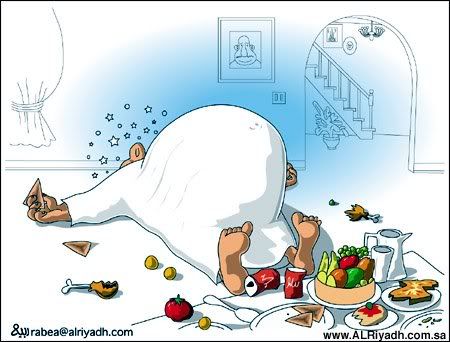
2. Too much stress on food and drink: For some people, the entire month of Ramadaan revolves around food. They spend the ENTIRE day planning, cooking, shopping and thinking about only food, instead of concentrating on Salaah, Quraan and other acts of worship. All they can think of is FOOD. So much so that they turn the month of 'fasting' into the month of 'feasting'. Come Iftaar time, their table is a sight to see, with the multitudes and varieties of food, sweets and drinks. They are missing the very purpose of fasting, and thus, increase in their greed and desires instead of learning to control them. It is also a kind of waste & extravagance.

".....and eat and drink but waste not by extravagance, certainly He (Allaah) likes not Al-Musrifoon (those who waste by extravagance)" [al-Araaf :31]

3. Spending all day cooking: Some of the sisters (either by their own choice or forced by their husbands) are cooking ALL day and ALL night, so that by the end of the day, they are too tired to even pray Ishaa, let alone pray Taraweeh or Tahajjud or even read Quraan. This is the month of mercy and forgiveness. So turn off that stove and turn on your Imaan!

4. Eating too much: Some people stuff themselves at Suhoor until they are ready to burst, because they think this is the way to not feel hungry during the day and some people eat at Iftaar, like there is no tomorrow, trying to 'make up for the food missed.' However, this is completely against the Sunnah. Moderation is the key to everything.

The Prophet (Sal Allaahu Alaiyhi wa Sallam) said: "The son of Adam does not fill any vessel worse than his stomach; for the son of Adam a few mouthfuls are sufficient to keep his back straight. If you must fill it, then one-third for food, one-third for drink and one-third for air." (Tirmidhi).

Too much food distracts a person from many deeds of obedience and worship, makes him lazy and also makes the heart heedless.

It was said to Imam Ahmad: Does a man find any softness and humility in his heart when he is full? He said, I do not think so.

5. Sleeping all day: Some people spend their entire day (or a major part of it) 'sleeping away their fast'. Is this what is really required of us during this noble month? These people also are missing the purpose of fasting and are slaves to their desires of comfort and ease. They cannot 'bear' to be awake and face a little hunger or exert a little self-control. For a fasting person to spend most of the day asleep is nothing but, negligence on his part.

6. Wasting time: The month of Ramadaan is a precious, precious time, so much so that Allaah calls this month "Ayyamum Ma'doodaat" (A fixed number of days). Before we know it, this month of mercy and forgiveness will be over. We should try and spend every moment possible in the worship of Allaah so that we can make the most of this blessing. However, there are some of us who waste away their day playing video games, or worse still, watching TV, movies or even listening to music. Subhaan Allaah! Trying to obey Allaah by DISOBEYING him!

7. Fasting but not giving up evil: Some of us fast but do not give up lying, cursing, fighting, backbiting, etc. and some of us fast but do not give up cheating, stealing, dealing in haraam, buying lotto tickets, selling alcohol, fornication, etc. and all kinds of impermissible things without realizing that the purpose of fasting is to not stay away from food and drink; rather the aim behind it is to fear Allaah.

"O you who believe! Fasting is prescribed for you as it was prescribed for those before you, that you may become Al-Muttaqoon (the pious)" [al-Baqarah 2:183]

The Prophet (Sal Allaahu Alaiyhi wa Sallam) said: "Whoever does not give up false speech and acting upon it, and ignorance, Allaah has no need of him giving up his food and drink." (Bukhaari)

8. Skipping Suhoor: The Prophet (Sal Allaahu Alaiyhi wa Sallam) said: "Eat suhoor for in suhoor there is blessing."(Bukhaari, Muslim).

And he (Sal Allaahu Alaiyhi wa Sallam) said: "The thing that differentiates between our fasting and the fasting of the People of the Book is eating suhoor." (Muslim)

9. Not fasting if they missed Suhoor: Some people are too scared to fast if they miss Suhoor. However, this is a kind of cowardice and love of ease. What is the big deal if you missed a few morsels of food? It's not like you will die. Remember, obedience to Allaah overcomes everything.

10. Delaying breaking fast: Some people wait until the adhaan finishes or even several minutes after that, just to be 'on the safe side'. However, the Sunnah is to hasten to break the fast, which means breaking fast whenever the adhaan starts, right after the sun has set. Aa'ishah (RA) said: This is what the Messenger of Allaah (Sal Allaahu Alaiyhi wa Sallam) used to do. (Muslim)

The Prophet (Sal Allaahu Alaiyhi wa Sallam) said: "The people will continue to do well so long as they hasten to break the fast." (Bukhaari, Muslim)

Determine to the best of your ability, the accuracy of your clock, calendar, etc. and then have tawakkul on Allaah and break your fast exactly on time.

11. Eating continuously until the time for Maghrib is up: Some people put so much food in their plates when breaking their fast and continue eating, enjoying dessert, drinking tea, etc., until they miss Maghrib. That is obviously not right. The Sunnah of the Prophet (pbuh) was that once he broke his fast with some dates, them he would hasten to the prayer. Once you are done with the prayer, you can always go back and eat some more if you wish.

12.Missing the golden chance of having your Dua accepted: The prayer of the fasting person is guaranteed to be accepted at the time of breaking fast.

The Prophet (Sal Allaahu Alaiyhi wa Sallam) said: "Three prayers are not rejected: the prayer of a father, the prayer of a fasting person, and the prayer of a traveler." (Tirmidhi).

Instead of sitting down and making Dua at this precious time, some people forego this beautiful chance, and are too busy frying samosas, talking, setting the food, filling their plates and glasses, etc. Think about it....Is food more important than the chance to have your sins forgiven or the fulfillment of your Duas.

13. Fasting but not praying : The fasting of one who does not pray WILL NOT BE ACCEPTED. This is because not praying constitutes kufr as the Prophet (Sal Allaahu Alaiyhi wa Sallam) said: "Between a man and shirk and kufr there stands his giving up prayer." (Muslim)

In fact, NONE of his good deeds will be accepted; rather, they are all annulled.

"Whoever does not pray 'Asr, his good deeds will be annulled." (Bukhaari)

14. Not fasting because of exams or work: Exams or work is NOT one of the excuses allowed by the Shariah to not fast. You can do your studying and revision at night if it is too hard to do that during the day. Also remember that pleasing and obeying Allaah is much more important than 'good grades'. Besides, if you will fulfil your obligation to fast, even if you have to study, Allaah will make it easy for you and help you in everything you do.

"Whosoever fears Allah, He will appoint for him a way out and provide for him from where he does not expect, Allah is Sufficient for whosoever puts his trust in Him." (Surah at-Talaaq 2-3)

15. Mixing fasting and dieting: DO NOT make the mistake of fasting with the intention to diet. That is one of the biggest mistakes some of us make (esp. sisters). Fasting is an act of worship and can only be for the sake of Allah alone. Otherwise, mixing it with the intention of dieting may become a form of (minor) Shirk.

16. Wasting the last part of Ramadaan preparing for Eid: Some people waste the entire last 10 days of Ramadaan preparing for Eid, shopping and frequenting malls, etc. neglecting Ibadah and Lailatul Qadr. although, the Prophet (Sal Allaahu Alaiyhi wa Sallam) used to strive the hardest during the last ten days of Ramadaan in worship (Ahmad, Muslim) and not in shopping. Buy whatever you need for Eid before Ramadaan so that you can utilize the time in Ramadaan to the max.

Aa'ishah (RA) said: "When the (last) ten nights began, the Messenger of Allaah (Sal Allaahu Alaiyhi wa Sallam)) would tighten his waist-wrapper (i.e., strive hard in worship or refrain from intimacy with his wives), stay awake at night and wake his family." (Bukhaari and Muslim).

17. Iftaar parties: Although inviting each other for breaking fast is something good and encouraged, some people go to extremes with lavish 'Iftaar parties' with all sorts of disobedience to Allaah, from flirting, mixing of the sexes and hijaab-less women, to show-off and extravagance, to heedlessness to Salaah, and Taraweeh to even music and dancing.

Labels: , ,

Special Ramadan Series

Dear Reader, Assalaamu’alaikum.

Ramadan Mubarak. We wish you a blessed and productive Ramadan! Make no mistake about it - keeping the fast and increasing our acts of worship during this blessed month is not an easy task. The physical demands of balancing work or school with fasting all day, feeling fatigued and less effective than you normally are, waking up for Suhoor, praying Teraweeh and Tahajjud prayers, dealing with sleep deficits.

But the last thing we would want is to let Ramadan pass us by without doing all that we aim and desire to. Do not allow yourself to feel guilty or regretful when Ramadan passes.

The Ramadan Series will send you emails with practical tips on how to gain and maintain the physical and spiritual energy necessary to embark on increased religious oligations so that you will reap the benefits from this blessed month. This includes special Ramadan duas to say during the month. Do sign-up today!

* Email
First Name
Last Name
* = Required Field

Article Link

Share

Thursday, August 20, 2009

The Meaning of Ramadan Kareem

Ramadan Kareem Meaning | Ramadan Mubarak Meaning

Ramadan Kareem is a greeting in the Arabic language that is used to wish happiness during the start of the holy month of Ramadan. The word Kareem means generous or bountiful in the Arabic language. Ramadan is the 9th month of the Muslim calendar. Muslims will wish each other Ramadan Kareem at the start of the Ramadan month. Also used is Ramadan Mubarak. Mubarak means blessed in the Arabic language.

The holy month of Ramadan is a very important month for Muslim because the first verses of the Holy Qur'an were revealed to Prophet Muhammad during a period of meditation and solitude in a cave near Mecca in the 7th Century. Therefore, Ramadan has been set aside for acts of worship and fasting. Muslims spend the month in meditation, prayer and abstinence from food, drinks, smoking and sexual acts between dawn and dusk.

The fast, during this month, is intended to be a challenging act taking the believer to a higher level of closeness to God. Some of the expected outcomes are cleansing of the soul by staying away from worldly pleasures, practicing self-discipline, sacrifice, generosity and charity.

Muslims believe that the gates of hell, and Satan are locked up during this month while the gates of heaves are open. Also, God forgives all previous sins of those who fast and pray sincerely during the month of Ramadan.

Muslims spend much time reading the Quran during this month. Many try to finish the enture Quran within the month, while others strive to complete the Quran several times.

Prophet Muhammad has said that:

Whosoever recites only one 'Ayat' in Holy Ramadan, he will be awarded as if he had recited the full Qur'an, in other months. Holy Prophet Mohammed (S.A.W.)

Labels: , ,

Special Ramadan Series

Dear Reader, Assalaamu’alaikum.

Ramadan Mubarak. We wish you a blessed and productive Ramadan! Make no mistake about it - keeping the fast and increasing our acts of worship during this blessed month is not an easy task. The physical demands of balancing work or school with fasting all day, feeling fatigued and less effective than you normally are, waking up for Suhoor, praying Teraweeh and Tahajjud prayers, dealing with sleep deficits.

But the last thing we would want is to let Ramadan pass us by without doing all that we aim and desire to. Do not allow yourself to feel guilty or regretful when Ramadan passes.

The Ramadan Series will send you emails with practical tips on how to gain and maintain the physical and spiritual energy necessary to embark on increased religious oligations so that you will reap the benefits from this blessed month. This includes special Ramadan duas to say during the month. Do sign-up today!

* Email
First Name
Last Name
* = Required Field

Article Link

Share

Wednesday, September 10, 2008

Ramadan Message 2008 - Day 10

Empty Coffee Cup, Full Heart

Some days will be harder than others. For some reason, I had a terrible headache this morning when I woke up. And it was difficult to concentrate on working with the continuous low intensity throbbing in my temples. I couldn't lie down to sleep, nor could I do anything functional. It is times such as this when one begins to think about why do this at all. Afterall, if I could have had my late morning coffee as I usually do while I worked on my computer, I knew I would not be having the throbbing headache.

No one ever said it would be an easy thing to do.

But there is a deeper meaning to this, for the empty coffee cup, and the empty plates, results in a filling of the heart (soul) through the purification process that the self-restraint in Ramadan brings us, the lucky observers.

Imam Mawlud writes in Matharat-al-Qulub,

I begin by starting with the heart of beginnings,
for it is the highest and noblest of beginnings.

Have courtesy with God, the High and the Majestic,
by practicing modesty and humility -

dejected out of shame and humility
humbled in awe, imploring Him -

by giving up your designs for His,
emptied of covetousness for what His servants have,

by hastening to fulfill His commands, and by being wary of
the subtle encroachment of bad manners.

If you - the spiritual aspirant - realize your attributes of
servitude, you will then be assisted with something of the
attributes of the Eternally Besought.

Realize your abject character and impoverishment, and you
will gain dignity and wealth from the All-Powerful.

There is no salvation like the heart's salvation,
given that all the limbs respond to its desires.

Labels: ,

Special Ramadan Series

Dear Reader, Assalaamu’alaikum.

Ramadan Mubarak. We wish you a blessed and productive Ramadan! Make no mistake about it - keeping the fast and increasing our acts of worship during this blessed month is not an easy task. The physical demands of balancing work or school with fasting all day, feeling fatigued and less effective than you normally are, waking up for Suhoor, praying Teraweeh and Tahajjud prayers, dealing with sleep deficits.

But the last thing we would want is to let Ramadan pass us by without doing all that we aim and desire to. Do not allow yourself to feel guilty or regretful when Ramadan passes.

The Ramadan Series will send you emails with practical tips on how to gain and maintain the physical and spiritual energy necessary to embark on increased religious oligations so that you will reap the benefits from this blessed month. This includes special Ramadan duas to say during the month. Do sign-up today!

* Email
First Name
Last Name
* = Required Field

Article Link

Share

Related Posts with Thumbnails