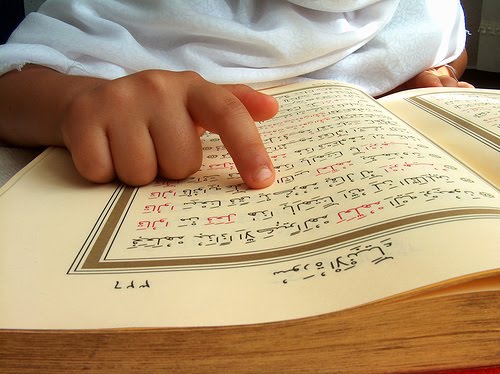
The month of Ramadan is the month in which the Quran was sent down,
a guidance for the people, and clear verses of guidance and criterion.
[Quran: Chapter 2:183]

Sponsored

Saturday, June 28, 2014

Best Way To Start Ramadan Suhaib Webb

The Best Way to Start Ramadan: Ramadān Reinforcement (Part 1)

By Suhaib Webb


One question I get asked a lot is  "What is the best way to start Ramadān?"

I thought about this for sometime, and here is my answer: "The best way to start Ramadān this year is the way you ended it last year."

Meaning: you should start Ramadān with the same passion, focus and commitment that you completed the last ten days of last year's Ramadān with. (if you didn't end it well last year, stay tuned for another short reminder soon: "How to fix a broken Ramadān?")

Do These Seven and Go to Heaven, Inshallah!
 
I know it sounds easy. But give it a try! Try having the same passion you had last year in the following areas today and see where it takes you tomorrow:

1. When you stand to pray, muster the passion you had a year ago as Ramadān came to a close. The concentration and taste of it should be in your heart, your body should be calm and your soul submerged in the light of prayer. The Prophet (sa) said, "Whoever prays and his/her soul does not disturb him/her during prayer, his/her sins are forgiven."

2. When you make dua, let it all out, give it to Allāh now, feeling impoverished to him like you did last year at the end of Ramadān. The Prophet (sa) said, "The supplications of a fasting person are accepted."

3. Let the tears flow now. Dry lands can't grow much and neither can dry hearts. A teacher once told me, "Tears come from fertile hearts like springs come from fertile soil." Sit alone with Allah and cry to him, seek him, beg him and flee to him "You will find him forgiving, merciful."

 4. When you remember Allah, do so with the same focus you did last year. Know that "Remember be and I will remember you" is happening every time His blessed names flows from your heart and speech, and that wherever you remember Him (work, home, mosque, school, alone or in a group), He mentions you in front of the angels, says your name and they seek blessings and forgiveness for you saying as is mentioned in the Qur'an,"Forgive those who believe, follow your path and save them from Hell."

5. Taste the sweetness of the hereafter, knowing the bitter taste of this life. Recall how your heart felt the last 10 days; there was nothing more valuable to you then drawing nearer to him and farther from excess here. Muster that passion now. Become a stranger in this life or a traveler because this is not your permanent abode! In the Qur'an, Allah addresses Adam and his wife saying, "You two get out of here (Paradise)." In other places He says, "You (all) get out of here."

My teacher said, "You all is all of us, Adam and his progeny. We were evicted from our real home and soon, God willing we will return to it if we lived good lives for Allah. This world is not it. Paradise awaits."

6. Guard your time now like you did last year. Ibn al-Qayyim said, "I know people more cautious with their time, than bankers are with money."

7. Guard your tongue and your character now like you did the last ten days a year ago! Recall the statement of our Prophet (sa) regarding a person who fails to look after the outer aspects of fasting, "Allah will say, 'I have no need that you left your food and drink."

Gain Infinite Openings
 
If you start this now, this struggle, God promises you openings and growth. He says,"Those who struggle in our way, we will guide them to infinite ways."

High Intensity Taqqrub
 
What you are doing when you take on Ramadān like this is intense taqarrub (seeking nearness to Allah, distance from sins and Satan). 

The Prophet (sa) said that Allah (swt) said, "A person does not come to me a hands length, except I come to him/her an arm's length. If he/she comes to me walking, I run to him/her."

If you take this bull by the horns and start this month off, with the same passion from a year ago, you are the person mentioned in the hadith above, inshallah.

Illuminated Endings are Rooted in Illuminated Beginnings
 
Remember! How you start now, tells a lot about last year and this year. Push yourself, asking God to dilate your heart and soul, filling it with guidance and light.

Sheikh al-Islām, Ahmed Zarūq (ra) said,
من كانت بالله بدايته, كانت إليه نهايته 
"Who's beginning was with Allah, then his ending is to Allah."

Labels: ,

Special Ramadan Series

Dear Reader, Assalaamu’alaikum.

Ramadan Mubarak. We wish you a blessed and productive Ramadan! Make no mistake about it - keeping the fast and increasing our acts of worship during this blessed month is not an easy task. The physical demands of balancing work or school with fasting all day, feeling fatigued and less effective than you normally are, waking up for Suhoor, praying Teraweeh and Tahajjud prayers, dealing with sleep deficits.

But the last thing we would want is to let Ramadan pass us by without doing all that we aim and desire to. Do not allow yourself to feel guilty or regretful when Ramadan passes.

The Ramadan Series will send you emails with practical tips on how to gain and maintain the physical and spiritual energy necessary to embark on increased religious oligations so that you will reap the benefits from this blessed month. This includes special Ramadan duas to say during the month. Do sign-up today!

* Email
First Name
Last Name
* = Required Field

Article Link

Share

Friday, July 29, 2011

Ramadan Checklist

We have created a simple Ramadan checklist with some important reminders for all of you to read.

But before we get into that, let's recall in brief what fasting entails from a physical aspect.

DEFINITION OF FASTING

Linguistically, fasting (sawm) means to refrain from something and in the usage of the Shari’ah it means to abstain from eating, drinking and conjugal relations from dawn to sunset with the [required] intention.

The time of fasting is from the beginning of dawn (i.e. Fajr) until sunset (i.e.
Maghrib). In countries where the [length of the] day and night are the same or the
day is very long, Muslims should fast according to the times of the nearest country.

PILLAR OF FASTING

Hence fasting has two pillars:

1. INTENTION
One must make the intention to fast. The Messenger of Allah said: “Verily
actions are [judged] by intention.” (Bukhari and Muslim)

2. REFRAINING FROM THINGS WHICH BREAK THE FAST
This means to abstain from eating, drinking and conjugal relations from sunrise
to sunset.


Now that we know what is expected from us, from a physical aspect, when we fast, let us see what is expected from us from a spiritual aspect during Ramadan. For that, we look to Muslim scholars, who explain what is the spiritual purposes of fasting.

On the purpose of fasting, Imam Al‐Ghazali writes:

"The purpose of fasting is that man should produce within him a semblance of the Divine attribute of Samadiyat (i.e. freedom from want), that he should, as far as possible, take after the angels and cast off the beastly propensities because the angels are free from desires and the place of man, too, is above the animals and he has been given the power of discrimination to resist the pressure of inordinate appetites. He is of course, inferior to angels in the sense that desire often overpowers him and he has to strive hard to subdue it. When he succumbs to sensual propensities he degenerates into the lowliest of lowly and joins the herds of cards while he conquers them he attains the dizzy heights of the heavenly host and begins to dwell on the plane of the angels."

Similarly Imam Ibn Al‐Qayyim writes:

"The purpose of fasting is that the spirit of man be released from the clutches of desire and moderation prevail in his carnal self and through it, he can realize the goal of purification and everlasting felicity. It is aimed at curtailing the intensity of desire and lust by means of hunger and thirst, at inducing man to realize how many were there in the world like him who had to go even without a small quantity of food, at making it difficult for Satan to deceive him, and at restraining his organs from turning towards things in which there was the loss of both the worlds. Fasting is thus the bridle of the God‐fearing, the shield of the warriors and the discipline of the virtuous."


Now that we have that covered and have the main idea in mind, let's get to the Ramadan checklist!

Ramadan Checklist

1) Not much time left before the onset of Ramadan for this year, but do know that Sunnah fasts of Shaban (the month before Ramadan) helps to prepare for Ramadan and help to make the transition into the holy month a smooth one.

2) Reduce TV watching and prepare family for the new spirit of Ramadan.

3) Take your Quran out. If you have trouble reading the Quran in Arabic, no need to worry. There are several good online sites that have simultaneous Arabic recitation and English translations to help you. Narrow down the websites (or forms of text or audio) you will frequently use during Ramadan.

4) Buy all necessities for the month of Ramadan in advance so you can spend less time during the holy month rushing around. You can be more focused on your religious rituals and spiritual development. Everyone in the family, even the kids, can participate, writing a shopping list, preparing some meals to be stored in the freezer. Some of the essential Ramadan items you should consider are dates and honey - both are considered prophetic foods, and are beneficial for the health especially this month when fasting.

5) Making dua (supplication) to Allah is encouraged throughout our lives. But this is highly recommended during Ramadan because Allah will grant a fasting person his wishes, if what is asked for is good for him, and He deems it so. We can make our dua in any language. Seek out recommended duas, or list out your own. Try to make a dua before breaking the fast. The Prophet peace be upon him said, "The fasting person has a supplication that is answered when he breaks his fast".

Check out this innovative and inspirational video done by our brothers in Malaysia on making the most of Ramadan.

Ramadan Special - Only Valid for the Next 30 Days
You Up For It???


Labels:

Special Ramadan Series

Dear Reader, Assalaamu’alaikum.

Ramadan Mubarak. We wish you a blessed and productive Ramadan! Make no mistake about it - keeping the fast and increasing our acts of worship during this blessed month is not an easy task. The physical demands of balancing work or school with fasting all day, feeling fatigued and less effective than you normally are, waking up for Suhoor, praying Teraweeh and Tahajjud prayers, dealing with sleep deficits.

But the last thing we would want is to let Ramadan pass us by without doing all that we aim and desire to. Do not allow yourself to feel guilty or regretful when Ramadan passes.

The Ramadan Series will send you emails with practical tips on how to gain and maintain the physical and spiritual energy necessary to embark on increased religious oligations so that you will reap the benefits from this blessed month. This includes special Ramadan duas to say during the month. Do sign-up today!

* Email
First Name
Last Name
* = Required Field

Article Link

Share

Tuesday, July 26, 2011

Fasting During the Summer in Ramadan


Fasting During the Summer in Ramadan

This Ramadan in North America and Europe, Muslims will begin fasting during the summer. In some places, like Sweden, daylight hours are long, with the breaking of fast at 9.15 pm. Muslims in the North American East Coast cities like Boston will break their fast at about 8 pm.

The long hours coupled with the heatwave that is being experienced by many North American cities, will mean a tough Ramadan for many Muslims.

Below is one journalist's take on fasting during the summer this Ramadan. Please pay attention to some of the tips given in the article below.

For more tips on, please refer to the compiled list of articles.

Remember that eating healthy during Ramadan will give us the necessary energy to embark on our increased religious obligations during this holy month.

US Muslims Prepare for Summertime Ramadan Fasting
RASHA MADKOUR, Associated Press
12:04 p.m., Monday, July 25, 2011

MIAMI (AP) — The Muslim holy month of Ramadan falls during the long, hot days of August this year, and Muslim Americans are getting ready to accommodate the daylight fasts required during Ramadan with adjustments in their schedules and eating habits. It can be even tougher for Muslims in America than for their counterparts in majority-Muslim countries, where business slows down during Ramadan and people take it easier during the day, says Dr. Elizabeth Rourke, an internist at Boston Medical Center.

"In the U.S., everyone is required to do what they would do ordinarily, the entire month," Rourke says, "so it makes the fast much more demanding for American Muslims."

Mubarakah Ibrahim, a personal trainer, hopes to cram all her clients in the morning when she has the most energy. She'll serve vegetables as the first course when her family breaks their fast in the evenings to make sure they get their nutrients for the day. And she'll buy her four kids — ranging in age from 10 to17 — shiny new water bottles as a reminder to hydrate during the hours they're not fasting.

"We know spirituality can get you through anything," says Ibrahim, who lives in New Haven, Conn. "But the choice really is, you can suffer through it and still do it, or you can do it and do it efficiently without making your health suffer."

Ramadan requires daily fasts of food and water during daytime hours. Typically observers eat a meal before dawn and break their fast at sunset. The fast-breaking meal — which varies by ethnic group but traditionally starts with a handful of sweet dates — is seen by many Muslims as an opportunity to gather with family and friends.

This year Ramadan begins Aug. 1, when the period from dawn to sunset in the continental U.S. can range from around 14 to around 16 hours, depending where you live. The Islamic calendar follows the lunar cycle, which is shorter than the sun-based Gregorian calendar, so Ramadan creeps up 11 days every year. Ramadan can last 29 or 30 days, again depending on the lunar cycle.

Fasting during Ramadan is one of the most important duties in Islam, one that even the not-so-religious typically observe. Children are not required to fast until they hit puberty, though many start building up to it when they're younger with half-day fasts. Also exempt are the elderly, women who are pregnant or nursing, and people with chronic medical conditions. But even for healthy Muslims, the daily fast from dawn until sunset can be grueling.

Rourke teaches medical residents about Ramadan and its implications for patients — how to adjust medication regimens to fit the daytime fast when possible, how to advise patients on avoiding dehydration, how to enlist help from a local religious leader if someone who shouldn't be fasting expresses the intention to do so.

Even for a totally healthy person to sustain that fast for a long period of time during a time where it can be very hot, it's a very demanding thing to ask of your body," Rourke says.

Sheikh Ali, a college student from Boca Raton, Fla., tries to ease his body into Ramadan mode by fasting intermittently the prior month, a practice of the Prophet Muhammad that some people emulate.

The premed chemistry major also extols the benefits of eating a high-fiber breakfast, like whole grain cereal, especially in the pre-dawn meal before fasting to help keep him feeling full.

Still, many Muslims say they won't do much differently this year and they're not too worried about the summer Ramadan.

"Once you've done it for this long," says Natasha Chida, a medical resident at the University of Miami who's been fasting since she was in middle school, "it's not really something that's physically difficult, it's just about continuing to learn self-restraint."

Beyond abstaining from food and drink, Muslims try to avoid negative words, thoughts and actions while fasting. Ramadan is seen as an opportunity to improve oneself, spiritually and personally.

Rizwan Jaka, a technology manager in Washington, D.C., puts the fast in perspective by reflecting on and empathizing with those in need, one of the main purposes of fasting.

"In the end, we have to realize that people go without food and water on a regular basis," Jaka says. Whatever hardships people feel during their fast, he adds, "we've got it easy compared to people who don't have access to food and running water."


Healthy Eating Habits Tips
During Ramadan at the Ramadan Blog!


What to Eat During Ramadan?

How to Fast Healthily During Ramadan

What to Avoid During Ramadan

Dates | Beneficial Things to Eat During Ramadan

Labels: ,

Special Ramadan Series

Dear Reader, Assalaamu’alaikum.

Ramadan Mubarak. We wish you a blessed and productive Ramadan! Make no mistake about it - keeping the fast and increasing our acts of worship during this blessed month is not an easy task. The physical demands of balancing work or school with fasting all day, feeling fatigued and less effective than you normally are, waking up for Suhoor, praying Teraweeh and Tahajjud prayers, dealing with sleep deficits.

But the last thing we would want is to let Ramadan pass us by without doing all that we aim and desire to. Do not allow yourself to feel guilty or regretful when Ramadan passes.

The Ramadan Series will send you emails with practical tips on how to gain and maintain the physical and spiritual energy necessary to embark on increased religious oligations so that you will reap the benefits from this blessed month. This includes special Ramadan duas to say during the month. Do sign-up today!

* Email
First Name
Last Name
* = Required Field

Article Link

Share

Tuesday, August 10, 2010

The Night Before Ramadan

It is only a matter of hours - 24 hours in some places, shorter still in other areas - where all Muslims all around the world will embark on fasting during Ramadan.

What Should You Be Doing the Night Before Ramadan?


1) If you have not already done so, you should plan on preparing your meal for Sahur (early morning meal before the start of the fast). Sahur meals should be simple, so do not invest too much of your energies in doing this.

2) Reserve some hours in your night for quiet reflection, reading the Quran, and prayer. Get used to doing this every day during Ramadan.

3) To achieve this, you will need to turn off the tv, radio and stop surfing the web for distractions. Again, this is something you should get used to during Ramadan, so you might as well start the night before Ramadan.

4) Declare your intention for the fast that you will be doing the following morning. "I intend to keep the fast for tomorrow in the month of Ramadan". In Arabic: "Wa bisawmi ghadinn nawaiytu min shahri Ramadan".

If you have an hour to spend, we recommend you watch the following video lecture by Sheikh Waleed Abdulhakeem on Ramadan, its history, its meaning, and practical tips on performing the fast during Ramadan properly, as well as on adopting the necessary attitude and behavior to achieve the maximum benefits.

The night before Ramadan, the first thing we did was to watch the video below to prepare ourselves for Ramadan 2010!


The Night Before Ramadan


Labels: ,

Special Ramadan Series

Dear Reader, Assalaamu’alaikum.

Ramadan Mubarak. We wish you a blessed and productive Ramadan! Make no mistake about it - keeping the fast and increasing our acts of worship during this blessed month is not an easy task. The physical demands of balancing work or school with fasting all day, feeling fatigued and less effective than you normally are, waking up for Suhoor, praying Teraweeh and Tahajjud prayers, dealing with sleep deficits.

But the last thing we would want is to let Ramadan pass us by without doing all that we aim and desire to. Do not allow yourself to feel guilty or regretful when Ramadan passes.

The Ramadan Series will send you emails with practical tips on how to gain and maintain the physical and spiritual energy necessary to embark on increased religious oligations so that you will reap the benefits from this blessed month. This includes special Ramadan duas to say during the month. Do sign-up today!

* Email
First Name
Last Name
* = Required Field

Article Link

Share

The Virtues of Ramadan

Ramadan is one of the twelve Arabic months. It is a month which is venerated in the Islamic religion, and it is distinguished from the other months by a number of characteristics and virtues, including the following:

1) Allah has made fasting this month the fourth pillar of Islam, as He says:

“The month of Ramadan in which was revealed the Quran, a guidance for mankind and clear proofs for the guidance and the criterion (between right and wrong). So whoever of you sights (the crescent on the first night of) the month (of Ramadan i.e. is present at his home), he must observe Sawm (fasts) that month…”
[al-Baqarah 2:185]

and it was narrated in al-Saheehayn (al-Bukhaari, 8; Muslim, 16) from the hadith of Ibn ‘Umar that the Prophet (peace and blessings of Allah be upon him) said: “Islam is built on five (pillars): the testimony that there is no god except Allah and that Muhammad is the Messenger of Allah; establishing prayer; paying zakat; fasting Ramadan; and Hajj to the House (the Kabah).”

2) Allah revealed the Quran in this month, as He says in the verse quoted above:

“The month of Ramadan in which was revealed the Quran, a guidance for mankind and clear proofs for the guidance and the criterion (between right and wrong)…”
[al-Baqarah 2:185]

And Allah says:

“Verily, We have sent it (this Quran) down in the Night of Al-Qadr (Decree).”
[al-Qadr 97:1]

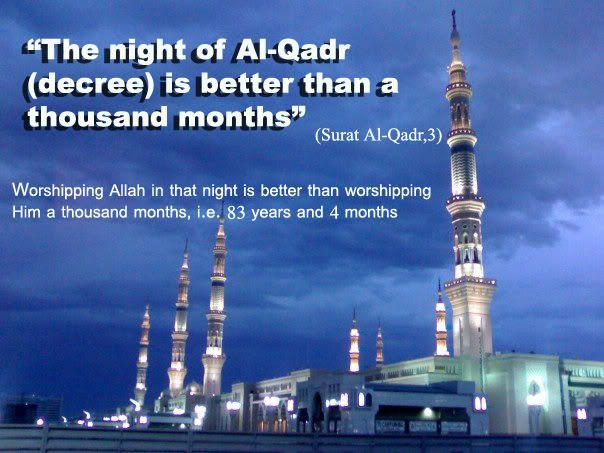
3) Allah has made Laylat al-Qadr in this month, which is better than a thousand months, as Allah says:

“Verily, We have sent it (this Quran) down in the Night of Al-Qadr (Decree).

And what will make you know what the Night of Al-Qadr (Decree) is?

The Night of Al-Qadr (Decree) is better than a thousand months (i.e. worshiping Allah in that night is better than worshiping Him a thousand months, i.e. 83 years and 4 months).

Therein descend the angels and the Rooh [Jibreel (Gabriel)] by Allaah’s Permission with all Decrees,
(All that night), there is peace (and goodness from Allaah to His believing slaves) until the appearance of dawn”
[al-Qadar 97:1-5]

“We sent it (this Quran) down on a blessed night [(i.e. the Night of Al-Qadr) in the month of Ramadan — the 9th month of the Islamic calendar]. Verily, We are ever warning [mankind that Our Torment will reach those who disbelieve in Our Oneness of Lordship and in Our Oneness of worship]”
[al-Dukhaan 44:3]

Allah has blessed Ramadan with Laylat al-Qadr. Explaining the great status of this blessed night, Surat al-Qadr was revealed, and there are many a hadith which also speak of that, such as the hadith of Abu Hurayrah (may Allah be pleased with him) who said: The Messenger of Allah (peace and blessings of Allah be upon him) said: “There has come to you Ramadan, a blessed month which Allah has enjoined you to fast, during which the gates of heaven are opened and the gates of Hell are closed, and the rebellious devils are chained up. In it there is a night which is better than a thousand months, and whoever is deprived of its goodness is indeed deprived.”
Narrated by al-Nasaa’i, 2106; Ahmad, 8769. classed as saheeh by al-Albaani in Saheeh al-Targheeb, 999.

And Abu Hurayrah (may Allah be pleased with him) said: The Messenger of Allah (peace and blessings of Allah be upon him) said: “Whoever spends Laylat al-Qadr in prayer out of faith and in the hope of reward, will be forgiven his previous sins.” Narrated by al-Bukhari, 1910; Muslim, 760.

4) Allah has made fasting Ramadan and spending its nights in prayer out of faith and in the hope of reward a means of forgiveness of sins, as was proven in al-Saheehayn (al-Bukhaari, 2014; Muslim, 760) from the hadith of Abu Hurayrah according to which the Prophet (peace and blessings of Allah be upon him) said: “Whoever fasts Ramadan out of faith and in the hope of reward, his previous sins will be forgiven.” And al-Bukhaari (2008) and Muslim (174) also narrated from Abu Hurayrah that the Prophet (peace and blessings of Allah be upon him) said: “Whoever spends the nights of Ramadan in prayer out of faith and in the hope of reward, his previous sins will be forgiven.”

The Muslims are unanimously agreed that it is Sunnah to pray qiyaam at night in Ramadan. Al-Nawawi said that what is meant by praying qiyaam in Ramadan is to pray Taraweeh, i.e., one achieves what is meant by qiyaam by praying Taraaweeh.

5) In this month, Allah opens the gates of Paradise and closes the gates of Hell, and chains up the devils, as is stated in al-Saheehayn (al-Bukhaari, 1898; Muslim, 1079), from the hadith of Abu Hurayrah who said that the Messenger of Allah (peace and blessings of Allah be upon him) said: “When Ramadan comes, the gates of Paradise are opened and the gates of Hell are closed, and the devils are chained up.”

6) Every night Allah has people whom He redeems from the Fire. Imam Ahmad (5/256) narrated from the hadith of Abu Umaamah that the Prophet (peace and blessings of Allah be upon him) said: “At every breaking of the fast, Allah has people whom He redeems.” Al-Mundhiri said: there is nothing wrong with its isnaad; and it was classed as saheeh by al-Albaani in Saheeh al-Targheeb, 987.

Al-Bazzaar (Kashf 962) narrated that Abu Sa’eed said: The Messenger of Allaah (peace and blessings of Allah be upon him) said: “Allah has people whom He redeems every day and night – i.e., in Ramadan – and every Muslim every day and night has a prayer that is answered.”

7) Fasting Ramadan is a means of expiation for the sins committed since the previous Ramadan, so long as one avoids major sins. It was proven in Saheeh Muslim (233) that the Prophet (peace and blessings of Allah be upon him) said: “The five daily prayers, from one Jumu’ah to the next and from one Ramadan to the next are expiation for (sins committed) in between, so long as you avoid major sins.”

8) Fasting in Ramadan is equivalent to fasting ten months, as is indicated by the hadith in Saheeh Muslim (1164) narrated from Abu Ayyoob al-Ansaari: “Whoever fasts Ramadan then follows it with six days of Shawwaal, it will be like fasting for a lifetime.” Ahmad (21906) narrated that the Prophet (peace and blessings of Allah be upon him) said: “Whoever fasts Ramadan, a month is like ten months, and fasting six days after al-Fitr will complete the year.”

9) Whoever prays qiyaam in Ramadan with the imam until he finishes, it will be recorded for him that he spent the whole night in prayer, because of the report narrated by Abu Dawood (1370) and others from the hadith of Abu Dharr (may Allah be pleased with him) that the Messenger of Allah (peace and blessings of Allah be upon him) said: “Whoever prays qiyaam with the imam until he finishes, it will be recorded for him that he spent the whole night in prayer.” Classed as saheeh by al-Albaani in Salaat al-Taraaweeh, p. 15

10) ‘Umrah in Ramadan is equivalent to Hajj. Al-Bukhaari (1782) and Muslim (1256) narrated that Ibn ‘Abbaas said: The Messenger of Allah (peace and blessings of Allah be upon him) said to a woman among the Ansaar, “What kept you from doing Hajj with us?” She said, “We only had two camels that we used for bringing water.” So her husband and son had gone for Hajj on one camel, and he left the other for them to use for bringing water.” He said, “When Ramadan comes, go for ‘Umrah, for ‘Umrah in Ramadan is equivalent to Hajj.” According to a report narrated by Muslim, “… is equivalent to doing Hajj with me.”

11) It is Sunnah to observe i’tikaaf (retreat for the purpose of worship) in Ramadan, because the Prophet (peace and blessings of Allah be upon him) always did that, as it was narrated in the hadith of ‘Aa’ishah (may Allah be pleased with her) that the Prophet (peace and blessings of Allah be upon him) used to spend the last ten days of Ramadan in i’tikaaf until he passed away, then his wives observed i’tikaaf after him.” Narrated by al-Bukhaari, 1922; Muslim, 1172.

12) It is mustahabb in the sense of being strongly recommended in Ramadan to study the Quran together and to read it a great deal. You may study the Quran together by reciting it to someone else and by having someone else recite it to you. The evidence that this is mustahabb is the fact that Jibreel used to meet the Prophet (peace and blessings of Allah be upon him) every night in Ramadan and study the Quran with him. Narrated by al-Bukhaari, 6; Muslim, 2308.

Reading Quran is mustahabb in general, but more so in Ramadan.

13) It is mustahabb in Ramadan to offer iftar to those who are fasting, because of the hadith of Zayd ibn Khaalid al-Juhani (may Allah be pleased with him) who said: The Messenger of Allah (peace and blessings of Allah be upon him) said: “Whoever gives iftar to one who is fasting will have a reward like his, without that detracting from the fasting person’s reward in the slightest.” Narrated by al-Tirmidhi, 807; Ibn Maajah, 1746; classed as saheeh by al-Albaani in Saheeh al-Tirmidhi, 647. see question no: ( 12598 )

And Allah knows best.
Source: Islam Q&A

Labels: , ,

Special Ramadan Series

Dear Reader, Assalaamu’alaikum.

Ramadan Mubarak. We wish you a blessed and productive Ramadan! Make no mistake about it - keeping the fast and increasing our acts of worship during this blessed month is not an easy task. The physical demands of balancing work or school with fasting all day, feeling fatigued and less effective than you normally are, waking up for Suhoor, praying Teraweeh and Tahajjud prayers, dealing with sleep deficits.

But the last thing we would want is to let Ramadan pass us by without doing all that we aim and desire to. Do not allow yourself to feel guilty or regretful when Ramadan passes.

The Ramadan Series will send you emails with practical tips on how to gain and maintain the physical and spiritual energy necessary to embark on increased religious oligations so that you will reap the benefits from this blessed month. This includes special Ramadan duas to say during the month. Do sign-up today!

* Email
First Name
Last Name
* = Required Field

Article Link

Share

Wednesday, August 4, 2010

Preparing for Ramadan 2010

Preparing for Ramadan 2010: Video Series
Highlights of "The Fast of Ramadan" Talk by Imam Zaid Shakir and Imam Suhaib Webb


The month of Ramadan is the perfect opportunity for Muslims to repent and to make-up for slacking off on obligatory prayers. If Muslims were to fast, seek God and truly repent during Ramadan, God will pardon us for all of the sins we have committed.

The Quran was revealed to Prophet Muhammad during Ramadan, as were other religious revelations such as the Torah. As such, Ramadan is considered the month of guidance.

Fasting during Ramadan brings us closer to God in many ways. When we sleep less, and deny ourselves many things that have been halal (permissible) to us during other times such as eating and drinking during the day time, we increase our spiritual nature. With increased spirituality, it becomes easier for us to do the things during Ramadan that we struggle with at other times, such as reading the Quran or praying sunnah prayers. We do these things willingly during Ramadan.

Fasting is a requirement on all healthy Muslims, male and female past the age of puberty. We cannot pick and choose aspects of our religion that we like. Islam is about submitting to God - and fasting is an act of submission.

It was mentioned that balancing life's responsibilities during Ramadan can be difficult. For instance, pressures to study for exams, or to work. It is best not to neglect pursuit of spirituality (remembrance of God through reading the Quran or attending night sunnah prayers) because you are worried about life's responsibilities. Instead, work out a balance that is comfortable. If studying for exams, use the time spent on reading the Quran or attending night prayers as a needed break. You will find yourself less burdened, and refreshed to hit the books later when you need to.

Does Allah Pay My Paycheck?

Imam Webb related a story. During his youth, he used to work at a call center in the evenings. He would ask a Muslim brother to join him and friends for nightly prayers. But the friend would always decline to join them, preferring to continue putting more hours at the call center. But Imam Webb never failed to invite him along. One day out of exasperation, the friend said "Does Allah pay my paycheck?". The next day, this friend was fired from his job at the call center. This, despite his commitment to stay on at the job and not to join in for the night prayers.

So does Allah pay your paycheck? Definitely worth thinking deeply about it as you make your choices this Ramadan!

If you reject (Allah), Truly Allah has no need of you; but He likes not ingratitude from His servants: if you are grateful, He is pleased with you” (Qur'an 39 verse 7)


MeccaOne: The Fast of Ramadan & the Furious Shaitan / Pt I


MeccaOne: The Fast of Ramadan & the Furious Shaitan / Pt II


MeccaOne: The Fast of Ramadan & the Furious Shaitan / Pt III


Recommended: Articles on Preparing for Ramadan

Basic Facts on Ramadan

Setting Goals and Planning

Why do We Fast During Ramadan?

Reading the Quran During Ramadan

The Importance of the Month of Shaban

Fasting During Shaban

Video Series 1: Preparing for Ramadan

Video Series 2: Ramadan Advice by Sheikh Hamza Yusuf

Labels: , ,

Special Ramadan Series

Dear Reader, Assalaamu’alaikum.

Ramadan Mubarak. We wish you a blessed and productive Ramadan! Make no mistake about it - keeping the fast and increasing our acts of worship during this blessed month is not an easy task. The physical demands of balancing work or school with fasting all day, feeling fatigued and less effective than you normally are, waking up for Suhoor, praying Teraweeh and Tahajjud prayers, dealing with sleep deficits.

But the last thing we would want is to let Ramadan pass us by without doing all that we aim and desire to. Do not allow yourself to feel guilty or regretful when Ramadan passes.

The Ramadan Series will send you emails with practical tips on how to gain and maintain the physical and spiritual energy necessary to embark on increased religious oligations so that you will reap the benefits from this blessed month. This includes special Ramadan duas to say during the month. Do sign-up today!

* Email
First Name
Last Name
* = Required Field

Article Link

Share

Friday, July 23, 2010

Reading the Quran During Ramadan

Muslims Reciting the Quran During Ramadan

Muslims around the world will spend their Ramadan, not only fasting from dawn to dusk for a month, but many will also spend it reciting the Quran daily.

Majority of Muslims will attend nightly prayers called the Taraweeh, which are held at mosques. It is also possible to perform the Taraweeh prayers at home. Each night a section of the Quran (a juz: 1/30 of the Quran) will be recited during the Taraweeh prayers. By the end of the month, the entire Quran would have been recited. This prayer is performed after the last compulsory daily prayer of Isha'a.

It is not compulsory to attend the Taraweeh prayers, or to finish reciting all of the Quran during Ramadan. But there are multitude of benefits to be derived from it.

Benefits of Reading Quran

Reading Quran during Ramadan is one of the best and most virtuous of good deeds, because Ramadan is the month of the Quran. Allah says (interpretation of the meaning):

“The month of Ramadan in which was revealed the Quran, a guidance for mankind and clear proofs for the guidance and the criterion (between right and wrong)”
[al-Baqarah 2:185]

Jibreel used to come to the Prophet (peace and blessings of Allah be upon him) every night in Ramadan, and study the Quran with him. Narrated by al-Bukhari, 5; Muslim, 4268.

Al-Bukhari (4614) narrated from Abu Hurayrah (may Allah be pleased with him) that Jibreel used to review the Quran with the Prophet (peace and blessings of Allah be upon him) once each year, and in the year in which he died, he reviewed it with him twice. From this it may be understood that it is mustahab to read Quran a great deal and to study it during Ramadan.

In another hadith, A’ishah relates that the Prophet said:
Verily the one who recites the Qur’an beautifully, smoothly, and precisely, he will be in the company of the noble and obedient angels. And as for the one who recites with difficulty, stammering or stumbling through its verses, then he will have TWICE that reward.” [Al-Bukhari and Muslim]

If you require help in interpreting the Arabic in the Quran, we came across links that we recommend.

Recommended Audio Quran (with English translation):

http://www.alhudapk.com/audio-video/fahm-alquran-english/default.asp

http://www.quranexplorer.com/Quran/Default.aspx

http://www.quran.net/quran/transPickthalShakirAzhar.asp

http://tanzil.info

http://www.listen2quran.com/default.aspx

Labels: , ,

Special Ramadan Series

Dear Reader, Assalaamu’alaikum.

Ramadan Mubarak. We wish you a blessed and productive Ramadan! Make no mistake about it - keeping the fast and increasing our acts of worship during this blessed month is not an easy task. The physical demands of balancing work or school with fasting all day, feeling fatigued and less effective than you normally are, waking up for Suhoor, praying Teraweeh and Tahajjud prayers, dealing with sleep deficits.

But the last thing we would want is to let Ramadan pass us by without doing all that we aim and desire to. Do not allow yourself to feel guilty or regretful when Ramadan passes.

The Ramadan Series will send you emails with practical tips on how to gain and maintain the physical and spiritual energy necessary to embark on increased religious oligations so that you will reap the benefits from this blessed month. This includes special Ramadan duas to say during the month. Do sign-up today!

* Email
First Name
Last Name
* = Required Field

Article Link

Share

Tuesday, July 13, 2010

Ramadan Advice By Hamza Yusuf

Preparing for Ramadan 2010: Highlights of the Video Series on Ramadan Advice by Sheikh Hamza Yusuf

Sheikh Hamza Yusuf starts off the lecture by noting that Islam has 5 pillars: shahadah (oneness of God), prayer, zakat, fasting and hajj. All of the pillars, including fasting, are forms of protection (a protective shield) for believers. Sheikh Hamza Yusuf notes that the previous religions has had fasting in their religious traditions. Muslim fasting during Ramadan is an extension of the religious traditions of Judaism and Christianity. This is not something new to believers seeking God.

Why Fasting?

Fasting has been prescribed for believers so that we learn taqwa. Taqwa is from an Arabic root word that means protection. So fasting is viewed as a way of protecting oneself. Fasting helps to form a protective barrier (shield) between us and the things that can harm us. Fasting also brings us back to our true nature.

It has been recommended that when someone attacks you verbally, or offends you while you are fasting, that you say twice "I am fasting". The aim is to prevent yourself from reacting to negative outside stimuli. These unwanted stimuli can unsettle you and make you behave in a reactionary manner. This should be avoided because the aim of fasting is to bring you to a state of higher consciousness. And you cannot achieve this state if you are reactionary.

Too often, people succumb to "patterned behaviors". People are essentially sleeping. For example, people in bad relationships find themselves behaving in reactionary manner, stuck in a vicious cycle. Islam is about waking us up. It is said that one should consider oneself as being already in one's graves (as in, soul "wakes up" from grave upon the call on Judgment Day) - the point being, one should not to wait till that moment to wake up.

Fasting is one such way to wake up. One wakes up early morning to eat; one stays up late for night prayers.

Fasting is also not about eating - one should eat small morsels of food, and not gorge yourself. It is said that if one has to eat to fill, it should be in this order - 1/3rd of stomach for food, 1/3 for water, and 1/3 for breath. One has to eat what is necessary for survival, not in excess.

Essence of Ramadan

Sheikh Hamza Yusuf notes that the pre-Islamic Arabs regarded jahil (ignorance) in a different form from its literal Arabic meaning. They would respond to slights/offensive words or acts (ignorant acts) with disproportionate zeal. Their aim was to "out-jahil" (beat the others, figuratively speaking) with more ignorant acts. This form of behavior was raectionary. And contrary to the Islamic way.

The Islamic way is to show forbearance in the face of ignorance. This is the hallmark of those who follow the Prophet's path.

Sadly, this is not the face of Muslims today. You see anger and reactionary behavior. Contempt for non-Muslims is also prevalent. But this is not right. Avoid the zealotry of arrogant reaction. Be like the lion who walks with dignity (it is not about being meek as a lamb). Instead, the lion only attacks when it needs to, and that too, out of necessity, for food or out of defense. It never creates carnage for the sake of it.

The essence of Ramadan is to become aware of one's own nature, tongue, heart, eyes, ears, and to be aware of the gifts given to you by Allah. Look to Islam on how to structure your life - actions that are halal, haram and what is recommended.

Fasting helps you achieve forbearance and discipline. It brings tranquility to the heart. And when the heart it tranquil, it becomes acutely aware of Allah. This confers protection on you (others can't harm you) AND others are protected from you (you cannot harm others).

When we fast, we follow the prophetic traditions from times past. We are connecting with every seeker of God before us. This is time for us to turn off the television, stop the empty chatter and gossip. Spend your time remembering Allah through dhikr instead.

Trust in Allah

Sheikh Hamza Yusuf notes that the modern world is one that is very much fear-based. Feelings of doubt, fear and anxiety are prevalent. People are scared of losing their jobs, their wealth, worry about provisions of life. But when a believer has such feelings, he is simply not putting his trust in Allah.

He notes that it was entirely possible that such fears could come true - one could indeed lose it all. But if one seeks Allah, one gets everything one desires. Why? Because everything one desires is with Allah.

This state of fear, needs and wants are things that makes use miserable. Ramadan is about letting go of such doubts, fears and anxieties that plague our minds. Avoid being reactionary. Trust in Allah and recognize that the things in this life you will need, you already have - that is, faith.

---------------------

Ramadan Advice Part 1


Ramadan Advice Part 2


Ramadan Advice Part 3


This is an excellent message from Sheikh Hamza Yusuf. The point about how the people who are living their lives hobbled by doubts and fears are actually not trusting God was profound. Ramadan is a good time as any to let go for such fears, trust in God, and indulge in the activities that uplift one's spiritual development.

A timeless advice that we can use in our lives well beyond Ramadan. Definitely worth spending time listening to.

Recommended: Articles on Preparing for Ramadan

Basic Facts on Ramadan

Setting Goals and Planning

The Importance of the Month of Shaban

Fasting During Shaban

Video Series 1: Preparing for Ramadan

Labels:

Special Ramadan Series

Dear Reader, Assalaamu’alaikum.

Ramadan Mubarak. We wish you a blessed and productive Ramadan! Make no mistake about it - keeping the fast and increasing our acts of worship during this blessed month is not an easy task. The physical demands of balancing work or school with fasting all day, feeling fatigued and less effective than you normally are, waking up for Suhoor, praying Teraweeh and Tahajjud prayers, dealing with sleep deficits.

But the last thing we would want is to let Ramadan pass us by without doing all that we aim and desire to. Do not allow yourself to feel guilty or regretful when Ramadan passes.

The Ramadan Series will send you emails with practical tips on how to gain and maintain the physical and spiritual energy necessary to embark on increased religious oligations so that you will reap the benefits from this blessed month. This includes special Ramadan duas to say during the month. Do sign-up today!

* Email
First Name
Last Name
* = Required Field

Article Link

Share

Monday, July 12, 2010

Fasting in Shaban

Preparing for Ramadan 2010: Fasting in Shaban


Sha’baan is the name of the eighth month in the Islamic calendar. The month of Sha'baan in the Islamic calendar begins on July 13, 2010 on the Gregorian calendar.

Prophet Muhammad sal Allahu ‘alayhi wa sallamhas on Sha'baan

“That is a month to which people do not pay attention, between Rajab and Ramadan, and it is a month in which deeds are lifted up to the Lord of the Worlds. I like for my deeds to be lifted up when I am fasting.”

It is narrated in Abi Dawud that Sha’baan was the month the Prophet loved to fast in the most, outside of the obligatory fasting during the month of Ramadan.

The Prophet sal Allahu ‘alayhi wa sallam (SAW) told us to avoid fasting the last one or two days of Sha’bān. This comes to us from a Hadith reported in Bukhari and Muslim. Some say this is to kind of prepare for the month ahead of 30 days of straight fasting.

Prophet Muhammad (SAW) had said that during the night of 15th Shaaban the Almighty Allah (SWT) takes decisions in the matters of sustenance, life and death and welfare of the people.

Next to the "Night of Qadr" the night of 15th Shaban, Lailatul Barat is the most auspicious night (also known as Shab-e-Barat or Night of Baraat). According to Imam Muhammad bin Ali Al-Baqir (as) and Imam Ja'far bin Muhammad As Sadiq (as), the Almighty Allah (SWT) has promised to fulfill every legitimate desire put forward to Him tonight.

Night of Bara'ah or Lailatul Barat is a night in which special blessings are directed towards the Muslims as mentioned earlier. Therefore, this night should be spent in total submission to Almighty Allah (SWT), and one should refrain from all those activities, which may displease Allah (SWT).

In order to observe the Night of Bara'ah or Shab-e-Barat, one should remain awakened in this night as much as he can. If someone has better opportunities, he should spend the whole night in worship and prayer. However, if one cannot do so for one reason or another, he can select a considerable portion of the night, preferably of the second half of it for this purpose.

Recommended Fasts for the Islamic Lunar month of Sha'ban

1st, 2nd and 3rd of Sha'baan: 13 July, 14 July and 15 July 2010

and/or

1st Thursday, Mid-Wednesday and last Thursday of Sha'baan: 15 July, 28 July, 5 August 2010

and/or

13th, 14th and 15th of Shabaan: 25, 26 and 27 July 2010

or

Any Thursday, Friday and Saturday of Shaban

or

The last three days of Shaban to connect with the Holy month of Ramadan

Islamic Calendar 2010


Recommended: Articles on Preparing for Ramadan

Basic Facts on Ramadan

Setting Goals and Planning

The Importance of the Month of Shaban

Video Series: Preparing for Ramadan

Labels: ,

Special Ramadan Series

Dear Reader, Assalaamu’alaikum.

Ramadan Mubarak. We wish you a blessed and productive Ramadan! Make no mistake about it - keeping the fast and increasing our acts of worship during this blessed month is not an easy task. The physical demands of balancing work or school with fasting all day, feeling fatigued and less effective than you normally are, waking up for Suhoor, praying Teraweeh and Tahajjud prayers, dealing with sleep deficits.

But the last thing we would want is to let Ramadan pass us by without doing all that we aim and desire to. Do not allow yourself to feel guilty or regretful when Ramadan passes.

The Ramadan Series will send you emails with practical tips on how to gain and maintain the physical and spiritual energy necessary to embark on increased religious oligations so that you will reap the benefits from this blessed month. This includes special Ramadan duas to say during the month. Do sign-up today!

* Email
First Name
Last Name
* = Required Field

Article Link

Share

Wednesday, August 19, 2009

Preparing for Ramadan 2009: Video Lectures in English

Ramadan Mubarak Ramadan Kareem 2009!


In the continuing series on how to prepare to meet the challenges and reap the benefits of Ramadan 2009 (scroll below for links to more articles in the series), we have found a series of lectures by Sheikh Yasir Qadhi. He talks about a series of topics: why Muslims fast during Ramadan; why Ramadan is considered the most holy month in the Muslim calendar; what benefits Muslims gain by fasting; how we can better ourselves during this month; what are the minimum requirements asked of us during Ramadan, are just some of the topics addressed.

One of the interesting things he mentioned is that the gates of hell and Shaytan will be chained up during Ramadan. On other occasions, when we sin and we recognize that we have sinned, we tell ourselves that it is not we have who willingly sinned. Rather it was Shaytan who caused us to sin. In actuality, Shaytan only tempts us, or gives us suggestions, but it we who acts. But during Ramadan we have absolutely no excuse. Whatever sins we commit, we do it of our own accord. It is all us! So be wary of what we do during Ramadan. If we lose our temper, it is not Shaytan who has made us that way. It is doing of our own accord.

Allah's apostle said "When the month of Ramadan starts, the gates of the heaven are opened and the gates of hell and the devils are chained" [Bukhari]

The series of Ramadan lectures by Sheikh Yasir Qadhi is highly recommended. Well worth the time spent listening to it.


Part 1


Part 2


Part 3


Part 4


Part 5


Part 6


Part 7


Part 8


Part 9


Part 10


Preparing for Ramadan 2009 Articles

Muslims Around the World Prepare for Ramadan 2009

Preparing for Ramadan 2009: The Importance of the Month of Shaban

Preparing for Ramadan 2009: Setting Goals and Planning


Enjoy Ramadan Tastes from Around the World
Here on the Ramadan Blog!


Ramadan Iftar Recipe from India

Ramadan Iftar Recipe from Singapore

Ramadan Iftar Recipes | Middle East Soups

Ramadan Iftar Recipe from Morocco

Ramadan Iftar Recipe from Saudi Arabia

More on Ramadan Iftar Recipes

Labels: , ,

Special Ramadan Series

Dear Reader, Assalaamu’alaikum.

Ramadan Mubarak. We wish you a blessed and productive Ramadan! Make no mistake about it - keeping the fast and increasing our acts of worship during this blessed month is not an easy task. The physical demands of balancing work or school with fasting all day, feeling fatigued and less effective than you normally are, waking up for Suhoor, praying Teraweeh and Tahajjud prayers, dealing with sleep deficits.

But the last thing we would want is to let Ramadan pass us by without doing all that we aim and desire to. Do not allow yourself to feel guilty or regretful when Ramadan passes.

The Ramadan Series will send you emails with practical tips on how to gain and maintain the physical and spiritual energy necessary to embark on increased religious oligations so that you will reap the benefits from this blessed month. This includes special Ramadan duas to say during the month. Do sign-up today!

* Email
First Name
Last Name
* = Required Field

Article Link

Share

Sunday, August 16, 2009

Preparing for Ramadan 2009: Setting Goals and Planning


We are all very busy in our lives with many responsibilities to meet. We go to school, study, work, take care of the home and the family. While we desire to set time aside to prepare for Ramadan, it is often easier said than done. Today's article sets out tips to help you do just that and to overcome the lack of time complaint.

1) Declare your commitment

The first thing to do is to declare your intention to commit to "Preparing for Ramadan". This has been shown to effect changes in behavior. For instance, people who want to lose weight are often told to declare their intentions. Similarly, we should declare our intention to set time aside to prepare for Ramadan. Say it aloud, and even write it down in your journal, or better yet on a big card and then paste it in an area you can see. That will serve as a daily reminder of your commitment to set aside time to prepare for Ramadan.

2) The Ramadan Objectives List

After your night prayers, or whenever you find some alone time in a quiet place, you should sit and think about what you like to achieve during Ramadan. If you are always bad-tempered, then perhaps learning to restrain your bad temper can be an objective to achieve during Ramadan. This is called agenda-setting. You list out the things you would like to acomplish. Some objectives could include doing good deeds, helping your family around the house, and reading the Quran.

4) The Dua List

If you perform your Ramadan well and you are sincere, THIS is the holy month that God has said he will answer our prayers. Therefore, this is the month for you to decide on what you wish for in this life and the hereafter. You may desire to be forgiven for any previous sins, you may desire to be a better human being and so on. If is all right to ask for earthly things, like success at work, as well as for spritual things, like desire to enter paradise. God listens to us, so we should speak to God.

5) Planning

Once you have created your Ramadan goals and duas, you should look make a plan on how to realize the objectives during Ramadan. Be realistic about your plan. The key to achieving your goals is to set achievable targets. Do not be over-ambitious.

For instance, you may think you can finish reading the Quran well before the 30 days so that you may be able to finish the Quran reading twice during Ramadan. Some people can actually do that. But if you feel you might not be able to do it, then be realistic and divide it into small bits. For instance, you can read 4 pages of the Qur’an after every prayer. 5 prayers a day with 4 pages read each time would lead to 20 pages read a day. 20 pages are equivalent to 1 juz. And if you did that for 30 days, you would have finished the Qur’an!

Reminder:

Small steps lead to big things.

Remember that The Prophet, sal Allahu alayhi wa sallam told us:
“The deeds most loved by Allah are those done regularly, even if they are small.”

Be consistent. It would be beneficial if we could develop the habits during Ramadan that we can use throughout our lives!

Labels:

Special Ramadan Series

Dear Reader, Assalaamu’alaikum.

Ramadan Mubarak. We wish you a blessed and productive Ramadan! Make no mistake about it - keeping the fast and increasing our acts of worship during this blessed month is not an easy task. The physical demands of balancing work or school with fasting all day, feeling fatigued and less effective than you normally are, waking up for Suhoor, praying Teraweeh and Tahajjud prayers, dealing with sleep deficits.

But the last thing we would want is to let Ramadan pass us by without doing all that we aim and desire to. Do not allow yourself to feel guilty or regretful when Ramadan passes.

The Ramadan Series will send you emails with practical tips on how to gain and maintain the physical and spiritual energy necessary to embark on increased religious oligations so that you will reap the benefits from this blessed month. This includes special Ramadan duas to say during the month. Do sign-up today!

* Email
First Name
Last Name
* = Required Field

Article Link

Share

Saturday, August 15, 2009

Preparing for Ramadan 2009: The Importance of the Month of Shaban

A Muslim woman reads a copy of the Koran at the Istiqlal mosque during the second day of ramadan in Jakarta, Indonesia, the world's most populous Muslim-majority country, on September 2, 2008. (ADEK BERRY/AFP/Getty Images)

It is said that the month before Ramadan, that is, the month of Sha'ban, is a very important month. It is recommended that we begin preparing for Ramadan during the month of Sha'ban.

We should make use of our time wisely during Sha'ban. Marathoners prepare for their marathon competition months ahead of the actual day. And we should similarly prepare for our month of fasting, prayer and reflection ahead of time. It would not be good to enter Ramadan without preparations - we would be unduly tired, irritable from the lack of food, water and even sleep. Typically, takes a few days to adjust to the new routine. But with adequate preparation, we will not suffer, and instead able to enjoy the full benefit of Ramadan.

If we have developed bad habits over the last year - for instance, waking up late in the mornings, then we should begin to change those habits before Ramadan, so that we are able to wake up for our morning food and the prayers.

The merits of fasting and doing good during Sha'ban are also plentiful.

An excerpt from a useful article on the benefits of fasting during Sha'ban by Mufti Taqi Usmaani is below:

Sha’ban is one of the meritorious months for which we find some particular instructions in the Sunnah of Prophet Muhammad, Sall-Allahu alayhi wa sallam. It is reported in the authentic ahadith that Prophet Muhammad, Sall-Allahu alayhi wa sallam, used to fast most of the month in Sha’ban. These fasts were not obligatory on him but Sha’ban is the month immediately preceding the month of Ramadan. Therefore, some preparatory measures are suggested by Prophet Muhammad, Sall-Allahu alayhi wa sallam. Some of these are given below:

1. The blessed companion Anas, Radi-Allahu anhu, reports that Prophet Muhammad, Sall-Allahu alayhi wa sallam, was asked, “Which fast is the most meritorious after the fasts of Ramadan?” He replied, “Fasts of Shaban in honor of Ramadan.”

2. The blessed companion Usama ibn Zaid, Radi-Allahu anhu, reports that he asked Prophet Muhammad, Sall-Allahu alayhi wa sallam: “Messenger of Allah, I have seen you fasting in the month of Sha’ban so frequently that I have never seen you fasting in any other month.” Prophet Muhammad, Sall-Allahu alayhi wa sallam, replied: “That (Sha’ban) is a month between Rajab and Ramadan which is neglected by many people. And it is a month in which an account of the deeds (of human beings) is presented before the Lord of the universe, so, I wish that my deeds be presented at a time when I am in a state of fasting.”

3. Ummul Mu’mineen ‘Aishah, Radi-Allahu anha, says, “Prophet Muhammad, Sall-Allahu alayhi wa sallam, used to fast the whole of Sha’ban. I said to him, ‘Messenger of Allah, is Sha’ban your most favorite month for fasting?’ He said, ‘In this month Allah prescribes the list of the persons dying this year. Therefore, I like that my death comes when I am in a state of fasting.”

4. In another Tradition she says, “Prophet Muhammad, Sall-Allahu alayhi wa sallam, would sometimes begin to fast continuously until we thought he would not stop fasting, and sometimes he used to stop fasting until we thought he would never fast. I never saw the Messenger of Allah, Sall-Allahu alayhi wa sallam, fasting a complete month, except the month of Ramadan, and I have never seen him fasting in a month more frequently than he did in Sha’ban.”

5. In another report she says, “I never saw the Messenger of Allah, Sall-Allahu alayhi wa sallam, fasting in a month so profusely as he did in the month of Sha’ban. He used to fast in that month leaving only a few days, rather, he used to fast almost the whole of the month.”

6. Ummul-Mu’mineen Umm Salamah, Radi-Allahu anha, says: “I have never seen the Messenger of Allah fasting for two months continuously except in the months of Sha’ban and Ramadan.”

These reports indicate that fasting in the month of Sha’ban, though not obligatory, is so meritorious that Prophet Muhammad, Sall-Allahu alayhi wa sallam, did not like to miss it.

But it should be kept in mind that the fasts of Sha’ban are for those persons only who are capable of keeping them without causing deficiency in the obligatory fasts of Ramadan. Therefore, if one fears that after fasting in Sha’ban, he will lose strength or freshness for the fasts of Ramadan and will not be able to fast in it with freshness, he should not fast in Sha’ban, because the fasts of Ramadan, being obligatory, are more important than the optional fasts of Sha’ban. That is why Prophet Muhammad, Sall-Allahu alayhi wa sallam, himself has forbidden the Muslims from fasting one or two days immediately before the commencement of Ramadan. The blessed Companion Abu Hurairah, Radi-Allahu anhu, reports Prophet Muhammad, Sall-Allahu alayhi wa sallam, to have said, “Do not fast after the first half of the month of Sha’ban is gone.”

According to another report Prophet Muhammad, Sall-Allahu alayhi wa sallam has said: “Do not precede the month of Ramadan with one or two fasts.”

The essence of the above-quoted ahadith is that Prophet Muhammad, Sall-Allahu alayhi wa sallam, himself used to fast most of the month of Sha’ban, because he had no fear of developing weakness or weariness before the commencement of Ramadan. As for others, he ordered them not to fast after the 15th of Sha’ban for the fear that they would lose their strength and freshness before Ramadan starts, and would not be able to welcome the month of Ramadan with enthusiasm. (Source: albalagh.net)


We also came across this short lecture by Sheikh Husain Abdul Sattar that reminds us of what our purpose should be for Ramadan.


Lecture on How to Prepare for Ramadan
During the Month of Sha'ban


Highlights of the Lecture
:

It is deplorable for any Muslim to enter and exit the month of Ramadan in the exact same state especially when Ramadan is the month when God showers his infinite mercy to all believers at this period. Muslims should be mindful to prioritize their time for spiritual activities and Islamic responsibilities over earthly pursuits. For instance, a news or tv buff would rush home to watch or read the news. And miss out on prayer. But the world will continue as it is whether you are up-to-date on the news or not. It is YOU that would miss out on your rewards if you choose to forgo prayer over catching the latest news.

NOTE: The editors of this blog are seeking input from readers. If you wish to share with us your Ramadan experience, or write us an article on a topic about Ramadan, for instance, how Ramadan is celebrated in your country, your Ramadan reflections and good deeds, or even your favorite iftar recipes, please send us an email at ramadanblog (at) gmail (DOT) com.

Labels: ,

Special Ramadan Series

Dear Reader, Assalaamu’alaikum.

Ramadan Mubarak. We wish you a blessed and productive Ramadan! Make no mistake about it - keeping the fast and increasing our acts of worship during this blessed month is not an easy task. The physical demands of balancing work or school with fasting all day, feeling fatigued and less effective than you normally are, waking up for Suhoor, praying Teraweeh and Tahajjud prayers, dealing with sleep deficits.

But the last thing we would want is to let Ramadan pass us by without doing all that we aim and desire to. Do not allow yourself to feel guilty or regretful when Ramadan passes.

The Ramadan Series will send you emails with practical tips on how to gain and maintain the physical and spiritual energy necessary to embark on increased religious oligations so that you will reap the benefits from this blessed month. This includes special Ramadan duas to say during the month. Do sign-up today!

* Email
First Name
Last Name
* = Required Field

Article Link

Share

Thursday, August 13, 2009

Preparing for Ramadan 2009

As Muslims around the world prepare for Ramadan 2009, we thought it a great idea to take a look at Ramadan 2008 - in the form of beautiful pictures of Muslims around the world preparing, praying, contemplating and celebrating during the holy month of Ramadan.


Allah's Messenger said, "Many a one who fasts obtains
nothing from his fasting but thirst, and many a one who
prays during the night obtains nothing from his night prayers
but wakefulness."

Hadith - Al-Tirmidhi #1989, Narrated AbuHurayrah

First say to yourself what you would be;
and then do what you have to do.
Epictetus

We are What we Repeatedly Do
May the Month of Ramadan Instill in Us Habits for Our Lifetime


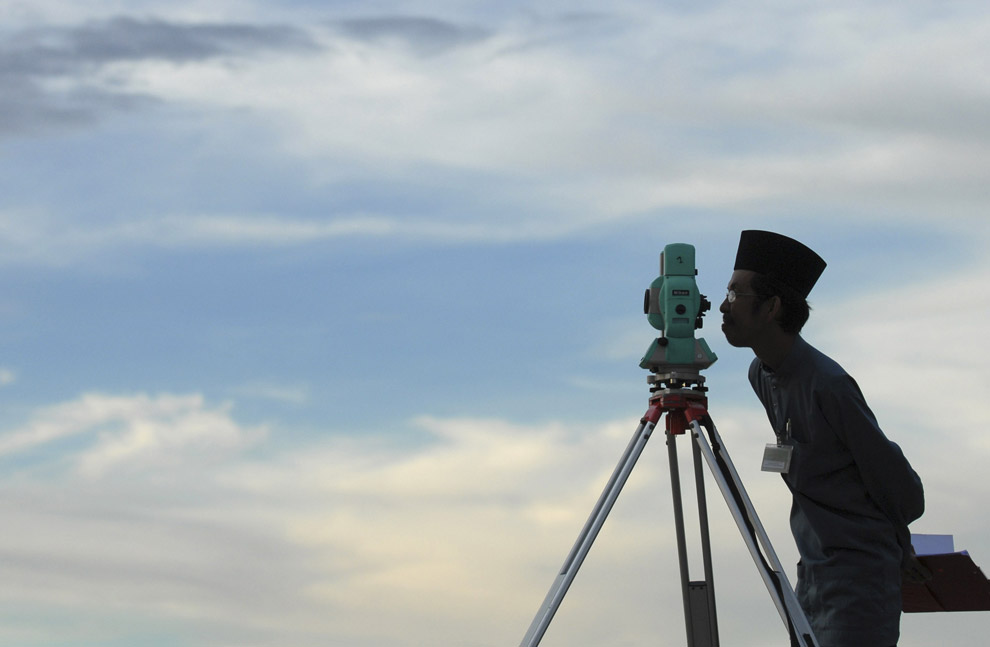
An officer of Brunei's Islamic authority looks through a telescope as he performs "rukyah", the sighting of the new moon for Ramadan, over the skies of Bukit Agok outside Bandar Seri Begawan August 31, 2008. Muslims scan the sky at dusk at the end of their lunar calendar's eighth month in search of the new moon to proclaim the beginning of Ramadan. (REUTERS/Ahim Rani)

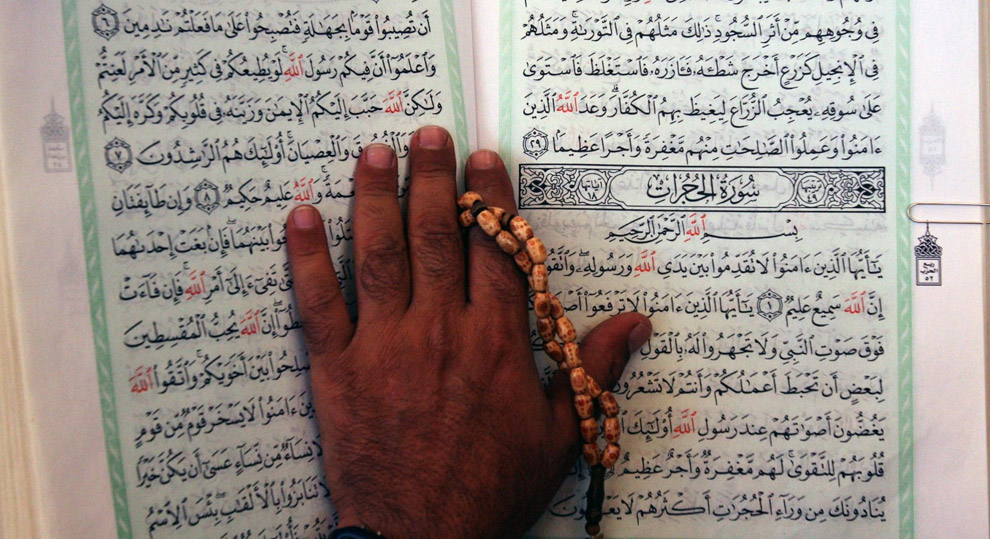
A Palestinian man reads from the Koran, during the Muslim holy fasting month of Ramadan, in a mosque in the West Bank city of Jenin, Thursday, Sept. 11, 2008. (AP Photo/Mohammed Ballas)

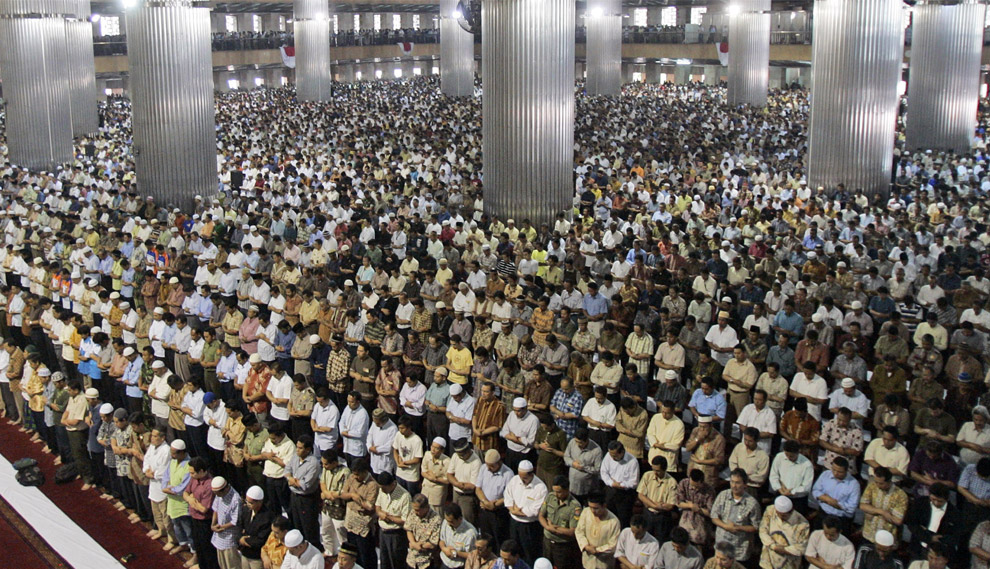
Indonesian men attend Friday prayer at Istiqlal mosque, the biggest in Southeast Asia, in Jakarta, Indonesia, Friday, Sept. 12, 2008. (AP Photo/Irwin Fedriansyah)

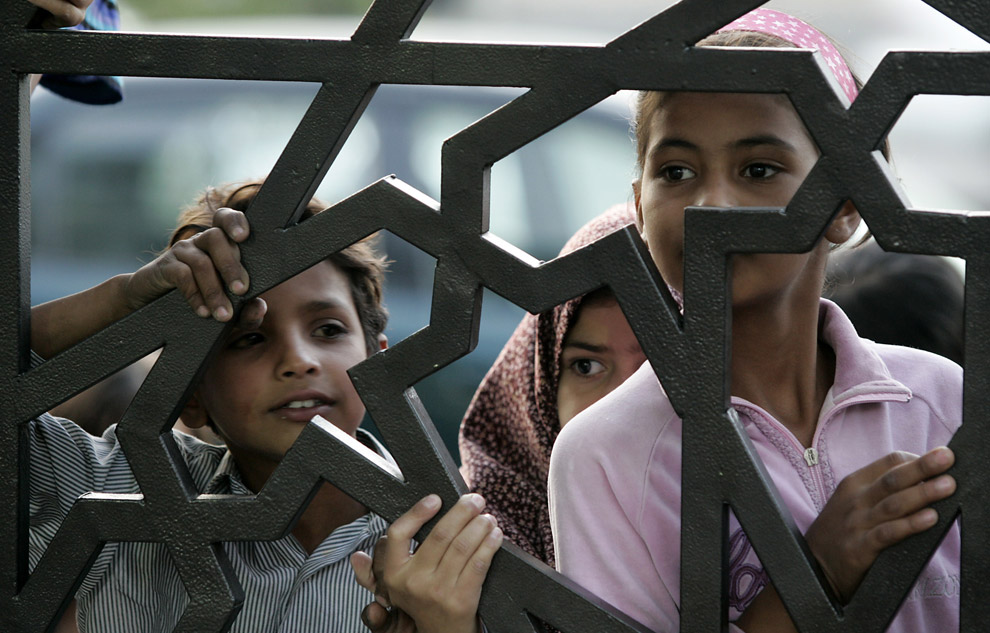
Jordanian Muslim girls queue in line outside a humanitarian center for waiting for meals to be donated at the time for the breaking of their fast, or Iftar, on the 13th day of the Muslim holy fasting month of Ramadan in Amman, Jordan, Saturday, Sept. 13, 2008. (AP Photo/Nader Daoud)

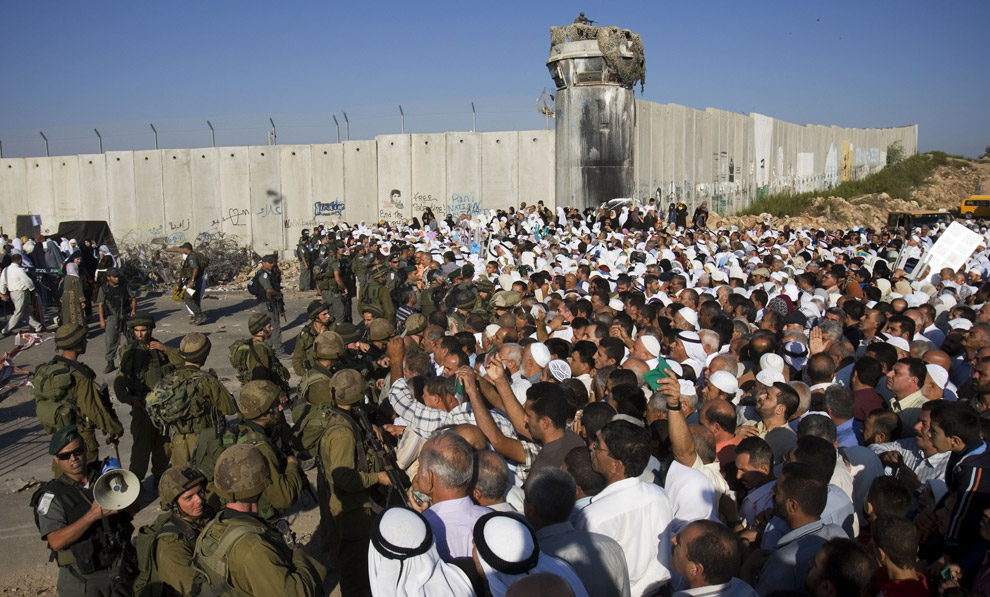
Israeli border police hold back Palestinians on their way to pray for the holy fasting month of Ramadan at the Al Aqsa Mosque in Jerusalem's Old City, at Kalandia checkpoint, between the West Bank town of Ramallah and Jerusalem, Friday, Sept. 12, 2008. (AP Photo/Bernat Armangue)

This picture taken September 5, 2008 shows a stall worker preparing roasted chicken wings to be sold at a Ramadan bazaar in downtown Kuala Lumpur for the breaking of their fast. In Muslim households across Asia, the inflation crisis is casting a shadow over the holy month of Ramadan, and making the nightly ritual of breaking the fast a more meagre affair. From Afghanistan to Malaysia, the high prices of food are forcing the poor to go without, and curtailing the lavish evening buffets which the well-off have flocked to in better economic times. (KAMARUL AKHIR/AFP/Getty Images)

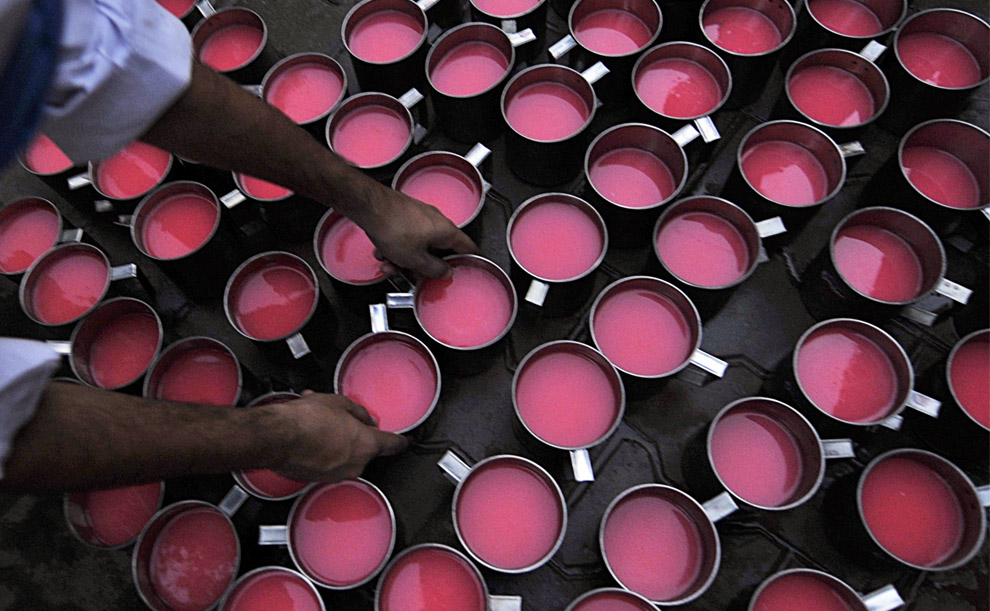
A Pakistani man prepares sweet drinks for people to break their fast at a mosque during the Muslim fasting month of Ramadan in Lahore on September 3, 2008. (Arif Ali/AFP/Getty Images)

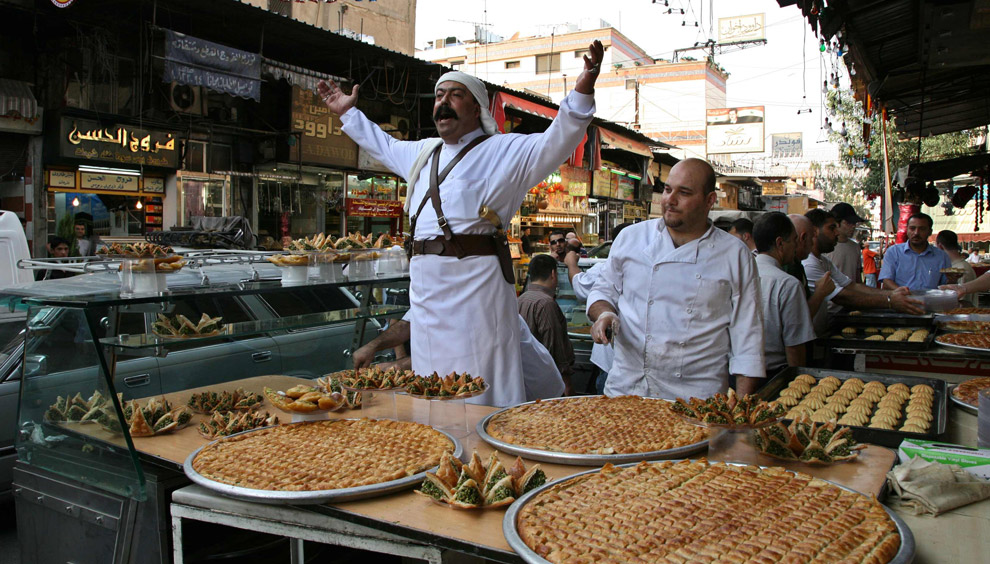
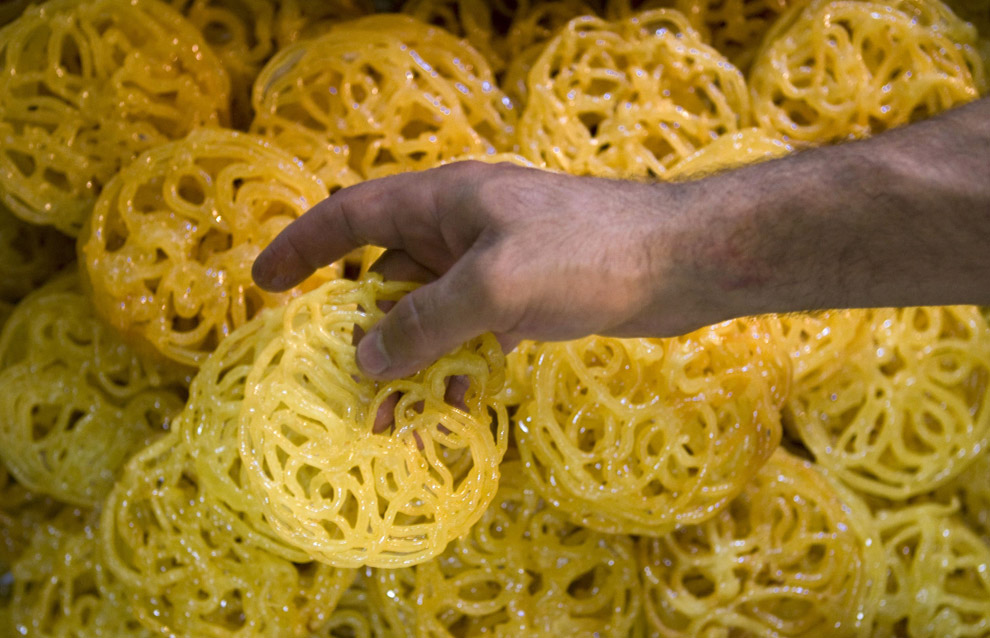
A seller of traditional Syrian sweets calls out for customers in the Meidan quarter of Damascus September 2, 2008. Sales of the sweets go up during the Muslim holy month of Ramadan. (REUTERS/Khaled al-Hariri)

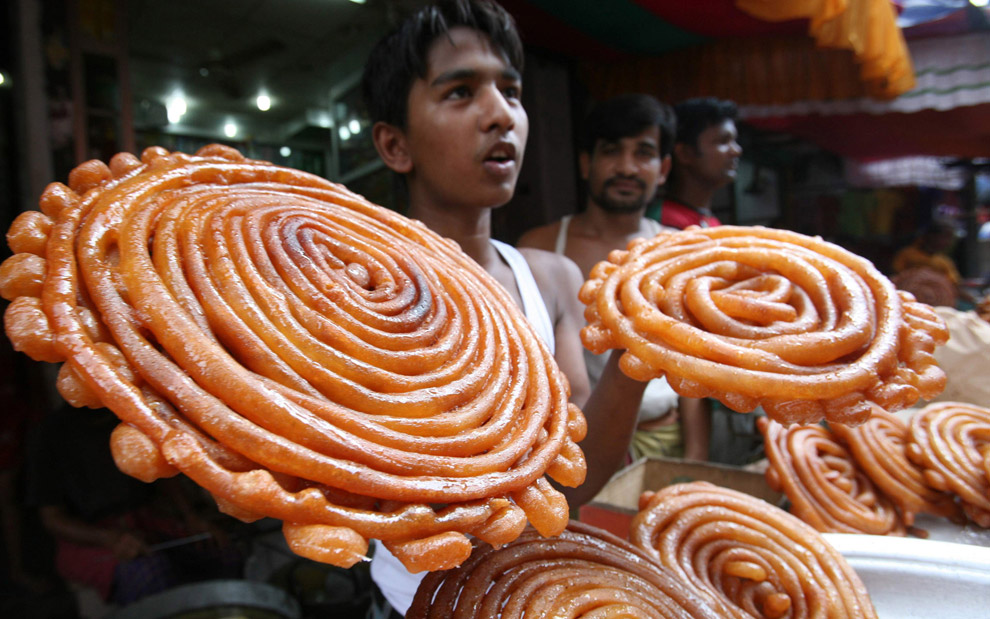
A Bangladeshi vendor sells traditional sweet meats for breaking the Ramadan fast, at the Chalk bazaar in Dhaka, Bangladesh, Friday, Sept. 12, 2008. (AP Photo/Pavel Rahman)

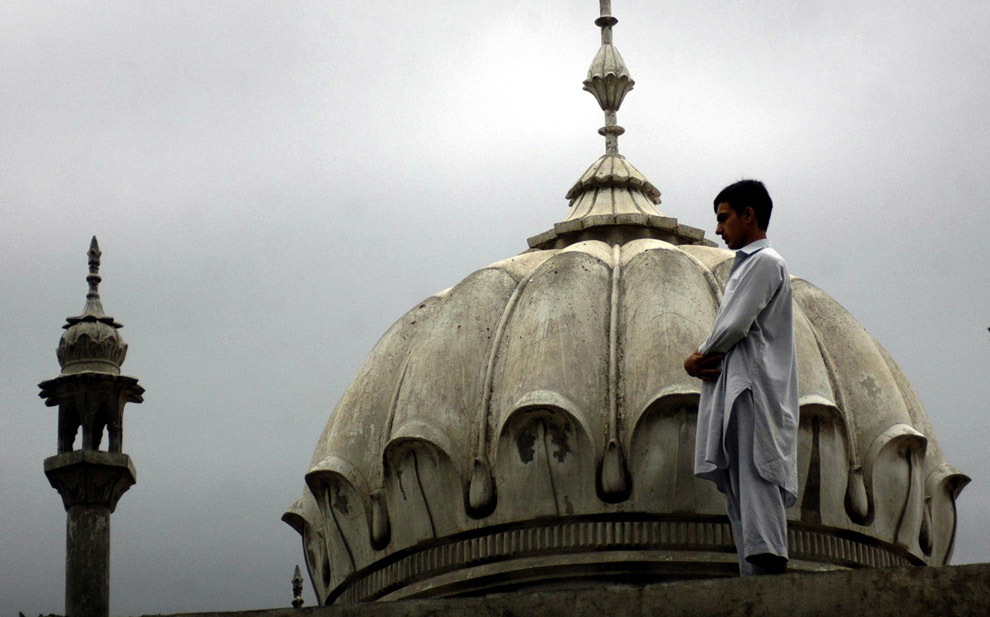
A Pakistani man offers Friday prayers atop a mosque roof during the holy Muslim month of Ramadan in Peshawar, Pakistan on Friday, Sept. 5, 2008. (AP Photo/Mohammad Sajjad)

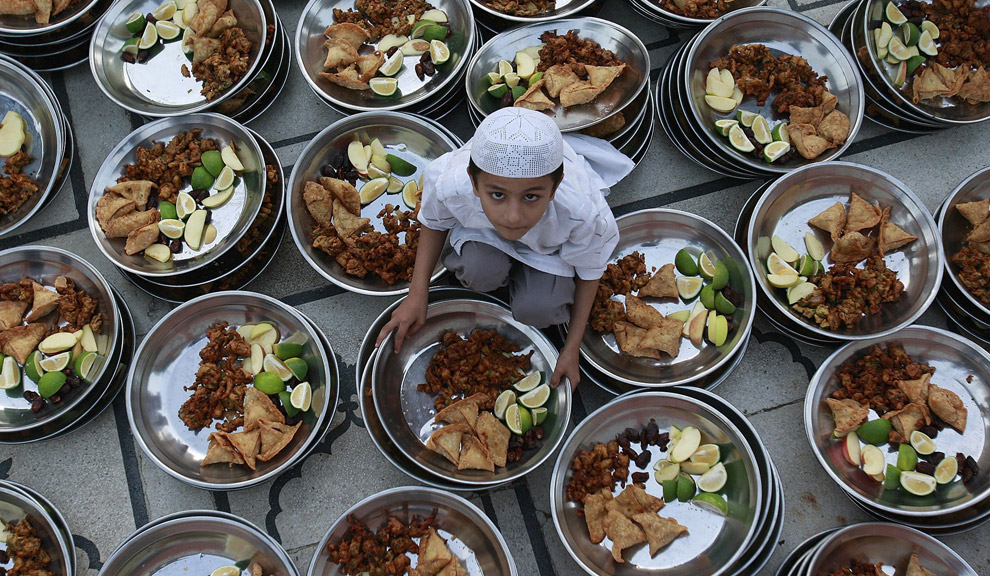
A child prepares food for Iftar (evening meal) before the breaking of fast on the first day of Ramadan at Memon Mosque in Karachi, Pakistan on September 2, 2008. (REUTERS/Athar Hussain)

A worker prepares traditional sweets at a pastry shop in Tehran, Iran on the fifth day of the Muslim fasting month of Ramadan September 6, 2008. (REUTERS/Morteza Nikoubazl)

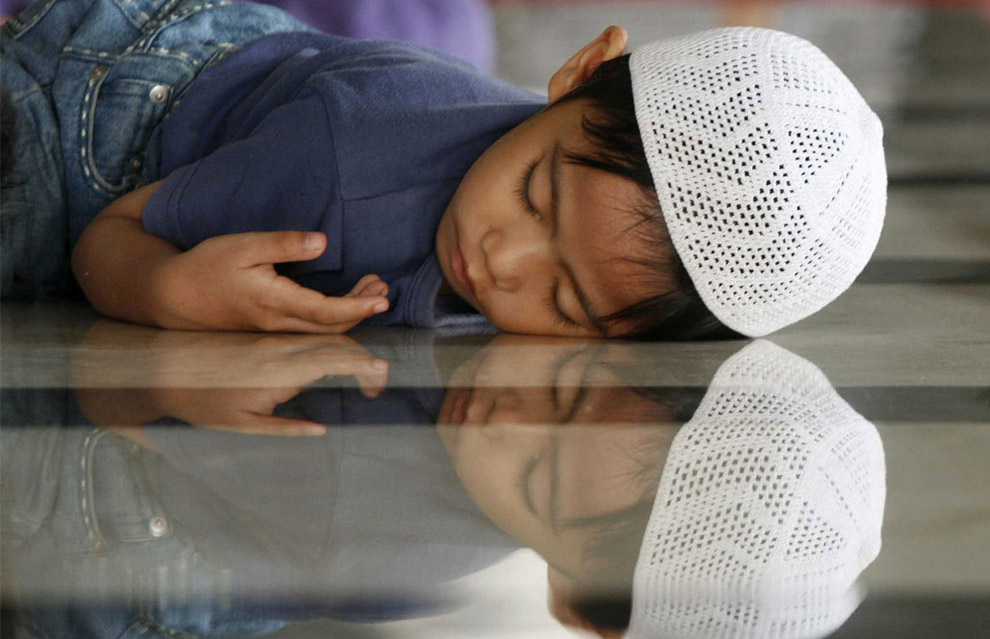
A boy sleeps in a mosque while waiting to break his fast on the first day of Ramadan in Makassar, Indonesia on September 1, 2008. (REUTERS/Yusuf Ahmad)

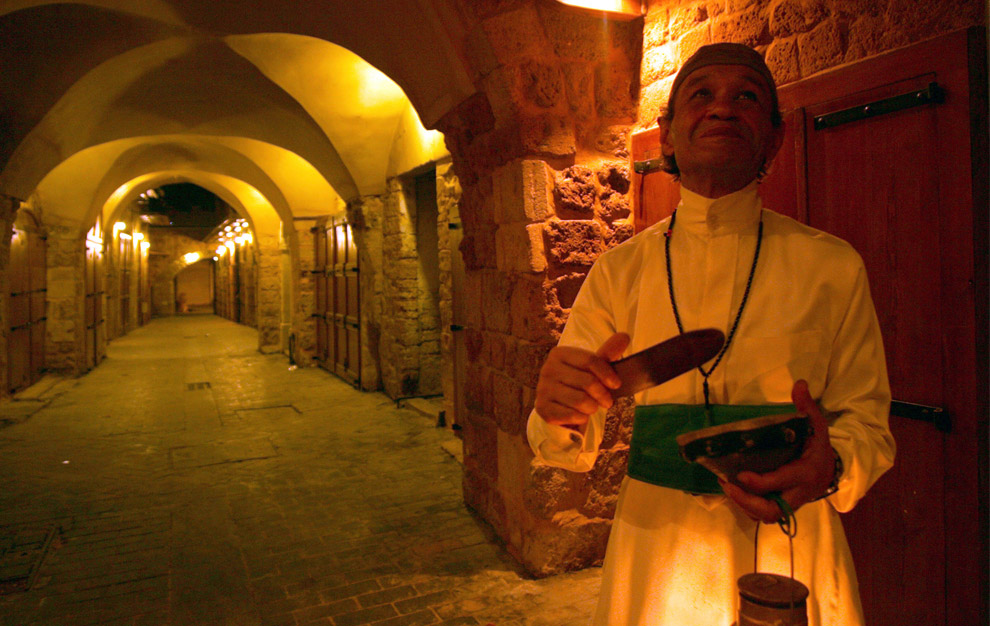
Lebanese "Musaharati" Mohammed Fanas wakes up observant Muslims for their overnight "suhur" meal before the day's fast in Sidon's Old City in south Lebanon just before dawn on September 3, 2008. (MAHMOUD ZAYAT/AFP/Getty Images)


Original Source of Photos:
http://www.boston.com/bigpicture/2008/09/observing_ramadan.html


NOTE: The editors of this blog are seeking input from readers. If you wish to share with us your Ramadan experience, or write us an article on a topic about Ramadan, for instance, how Ramadan is celebrated in your country, your Ramadan reflections and good deeds, or even your favorite iftar recipes, please send us an email at ramadanblog (at) gmail (DOT) com.

Labels: ,

Special Ramadan Series

Dear Reader, Assalaamu’alaikum.

Ramadan Mubarak. We wish you a blessed and productive Ramadan! Make no mistake about it - keeping the fast and increasing our acts of worship during this blessed month is not an easy task. The physical demands of balancing work or school with fasting all day, feeling fatigued and less effective than you normally are, waking up for Suhoor, praying Teraweeh and Tahajjud prayers, dealing with sleep deficits.

But the last thing we would want is to let Ramadan pass us by without doing all that we aim and desire to. Do not allow yourself to feel guilty or regretful when Ramadan passes.

The Ramadan Series will send you emails with practical tips on how to gain and maintain the physical and spiritual energy necessary to embark on increased religious oligations so that you will reap the benefits from this blessed month. This includes special Ramadan duas to say during the month. Do sign-up today!

* Email
First Name
Last Name
* = Required Field

Article Link

Share

Related Posts with Thumbnails